

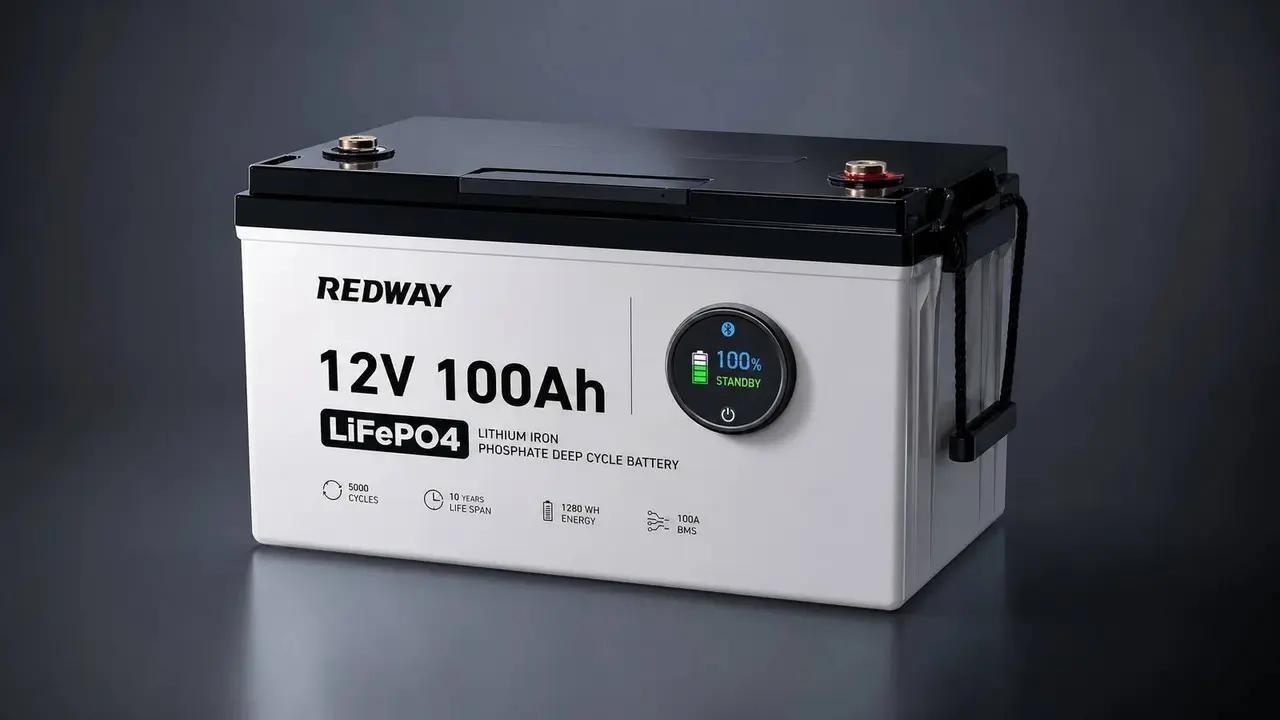
The 12V 100Ah LiFePO4 battery has become one of the most popular configurations in the lithium battery market — and for good reason. It is the right size for a wide range of applications, from marine and RV to solar storage and backup power. And the "smart" variant — with integrated Bluetooth monitoring and advanced BMS — represents the current state of the art.
Why 12V 100Ah is the Sweet Spot
The 12V 100Ah configuration delivers 1,280 watt-hours of usable energy (at 12.8V nominal). That is enough to:
- Power a 100W load for approximately 10 hours
- Run a 12V refrigerator for 24–48 hours
- Provide backup power for a home router and modem for several days
- Serve as a single-battery marine house bank for day trips
- State of Charge (SOC): Remaining capacity as a percentage
- Voltage: Pack voltage in real time
- Current: Charge or discharge current
- Temperature: Cell temperature monitoring
- Cycle Count: Total charge cycles completed
- Cell Balancing Status: Individual cell voltages
The 12V form factor is compatible with the vast majority of 12V charging systems — solar charge controllers, alternators, shore power converters — without requiring voltage conversion.
What Makes a Battery "Smart"
The "smart" designation refers to batteries equipped with Bluetooth communication capability, allowing real-time monitoring of battery state via a smartphone app. Key parameters visible through a smart BMS interface:
This visibility transforms battery management from guesswork to data-driven operation. You know exactly how much capacity remains, whether your charging system is performing correctly, and whether any cells are showing signs of imbalance.
LFP vs. Lead-Acid: The Numbers
For a 12V 100Ah application, the comparison between LFP and lead-acid is stark:
| Specification | LFP 100Ah | Lead-Acid 100Ah | |---|---|---| | Usable Capacity | 100Ah (100%) | 50Ah (50%) | | Cycle Life | 2,000–5,000 | 300–500 | | Weight | ~13 kg | ~28 kg | | Charge Time (20A) | ~5 hours | ~8–10 hours | | Self-Discharge | ~3% per month | ~5–10% per month |
The usable capacity difference is critical. Lead-acid batteries should not be discharged below 50% to preserve cycle life. LFP batteries can be safely discharged to near 0%. A 100Ah LFP battery delivers twice the usable energy of a 100Ah lead-acid battery.
Charging Considerations
LFP batteries require a charger designed for LFP chemistry. The charge profile is different from lead-acid:
- Bulk charge voltage: 14.4–14.6V (for 12V LFP)
- Absorption voltage: 14.4–14.6V
- Float voltage: 13.6V (or no float — LFP does not require float charging)
Using a lead-acid charger on an LFP battery will result in undercharging and reduced capacity. Most modern multi-stage chargers include an LFP mode.
Applications
Marine: 12V 100Ah LFP batteries are the standard choice for marine house banks. The weight savings versus lead-acid improve boat performance, and the longer cycle life reduces replacement frequency.
RV and Van Life: House bank applications where weight, cycle life, and depth of discharge capability are all important.
Solar Storage: Paired with a solar charge controller and inverter for off-grid power systems.
Backup Power: UPS and backup power applications where long standby life and reliable capacity are critical.
Lithium Battery Company's 12V LFP Packs
Lithium Battery Company supports 12V LFP battery programs in a range of capacities, from 20Ah to 400Ah and beyond. Every pack is built to order with fresh cells and includes a matched BMS with the protection features your application requires.
Custom configurations — non-standard dimensions, specialized connectors, specific BMS communication interfaces — are available for OEM programs. Contact our engineering team to discuss your requirements.