

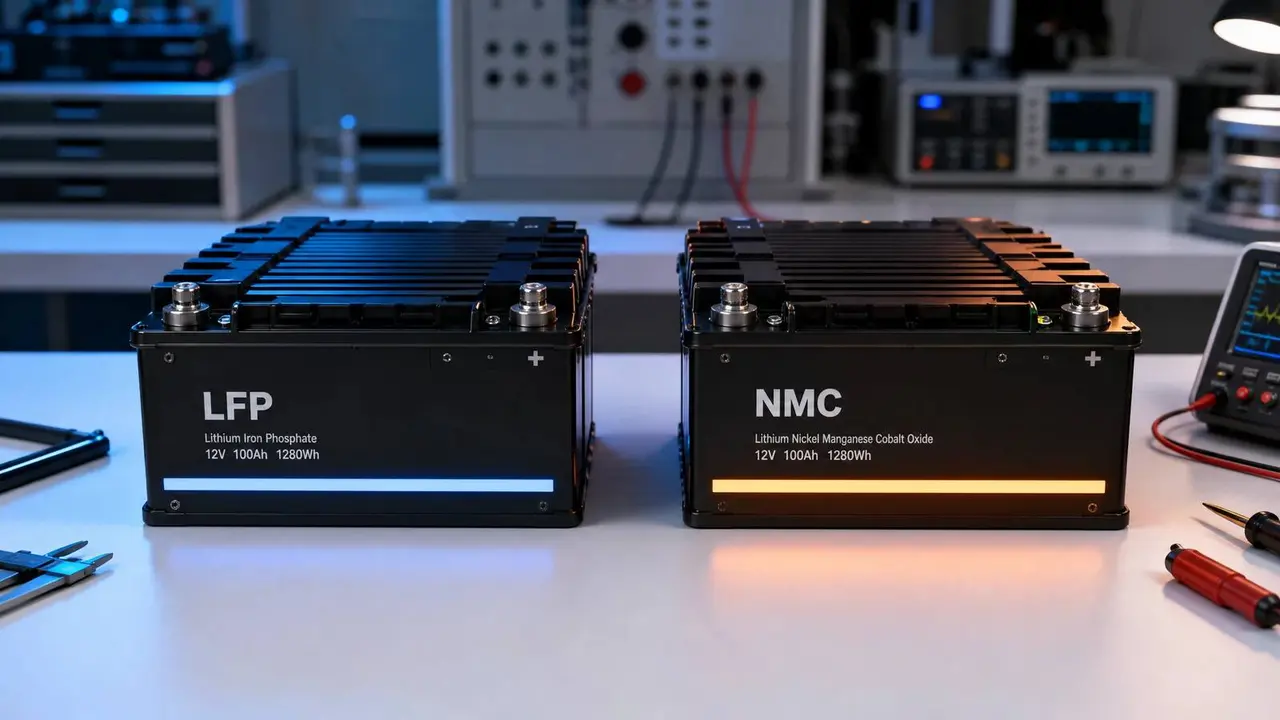
LFP (Lithium Iron Phosphate) is the better choice when safety, cycle life, and thermal stability are the priority. NMC (Nickel Manganese Cobalt) is the better choice when maximum energy density in the smallest possible form factor is required. Most OEM programs fall clearly into one camp once the application requirements are defined.
This guide covers every meaningful difference between LFP and NMC battery packs — chemistry, performance, safety, cost, certifications, and the specific applications where each chemistry dominates.
What Is an LFP Battery Pack?
An LFP battery pack uses Lithium Iron Phosphate (LiFePO4) as the cathode material. LFP cells operate at a nominal voltage of 3.2V per cell and are characterized by exceptional thermal stability, very long cycle life (3,000–6,000+ cycles to 80% capacity), and resistance to thermal runaway. LFP chemistry eliminates cobalt entirely, which removes both the cost volatility and the ethical supply chain concerns associated with cobalt mining.
LFP is the dominant chemistry for stationary energy storage, telecom backup power, defense ground systems, industrial OEM equipment, and any application where the battery will be cycled heavily over many years.
What Is an NMC Battery Pack?
An NMC battery pack uses Nickel Manganese Cobalt Oxide as the cathode material. NMC cells operate at a nominal voltage of 3.6–3.7V per cell and deliver energy densities of 150–250 Wh/kg — significantly higher than LFP (90–160 Wh/kg). The tradeoff is shorter cycle life (500–2,000 cycles) and greater sensitivity to high temperatures.
NMC is the dominant chemistry for UAV and drone programs, aerospace applications, electric vehicles where range is paramount, and any application where pack weight and volume are the primary engineering constraints.
LFP vs NMC: Head-to-Head Comparison
| Property | LFP | NMC | |---|---|---| | Nominal cell voltage | 3.2V | 3.6–3.7V | | Energy density | 90–160 Wh/kg | 150–250 Wh/kg | | Cycle life | 3,000–6,000+ cycles | 500–2,000 cycles | | Thermal runaway risk | Very low | Moderate | | Operating temperature | -20°C to +60°C | -20°C to +55°C | | Cobalt content | None | Yes (varies by ratio) | | Cost per kWh | Lower | Higher | | Best applications | Defense, telecom, ESS, industrial OEM | UAV, aerospace, EV, medical |
Which Applications Require LFP?
Telecom backup power is one of the clearest LFP use cases. Cell towers and data centers need batteries that cycle daily for 10–15 years without replacement. LFP's 3,000–6,000 cycle life makes it the only chemistry that delivers an acceptable total cost of ownership at scale. LFP is also a direct drop-in replacement for the VRLA lead-acid batteries that currently power most telecom infrastructure.
Defense and military ground systems favor LFP for its thermal stability and safety profile. A battery that will not enter thermal runaway under abuse conditions — puncture, overcharge, high ambient temperature — is a fundamental requirement for soldier-worn and vehicle-mounted systems. LFP meets MIL-STD-810 thermal and shock requirements more readily than NMC.
Industrial OEM equipment — AGVs, forklifts, floor scrubbers, industrial robots — typically runs one to three charge-discharge cycles per day, five to seven days per week. Over a 10-year equipment life, that is 3,000–10,000 cycles. Only LFP delivers that cycle life without pack replacement.
Stationary energy storage systems (ESS) at commercial and industrial facilities use LFP almost exclusively. The combination of long cycle life, no thermal runaway risk, and flat discharge curve makes LFP the standard chemistry for grid-tied and off-grid storage.
Which Applications Require NMC?
UAV and drone programs are the clearest NMC use case. Every gram of battery weight directly reduces payload capacity and flight time. NMC's higher energy density — up to 250 Wh/kg versus LFP's 160 Wh/kg — can reduce pack weight by 30–40% for the same energy content. For a 10kg UAV, that difference is mission-critical.
Aerospace and aviation applications require NMC for the same reason. DO-160 certified packs for avionics, satellite ground support, and airborne platforms are almost universally NMC because weight and volume constraints are absolute.
Medical devices — portable surgical tools, patient monitoring equipment, infusion pumps — use NMC for its compact form factor. IEC 62133-certified NMC packs deliver the energy density required for full-shift operation in a package that fits within the device envelope.
Electric vehicles in performance and range-focused applications use NMC. The higher energy density enables longer range without proportionally increasing pack weight and volume.
Can You Use LFP Where NMC Is Specified (or Vice Versa)?
In most cases, no — not without a redesign. LFP cells have a lower nominal voltage (3.2V vs 3.6V), which changes the pack voltage for any given series configuration. A 4S LFP pack produces 12.8V nominal; a 4S NMC pack produces 14.4–14.8V nominal. Swapping chemistry in an existing design requires recalculating the cell configuration, BMS parameters, and charge profile.
The exception is applications where the system voltage is flexible and the designer is choosing chemistry before finalizing the pack architecture. In those cases, both chemistries should be evaluated against the full application requirements.
Frequently Asked Questions
Q: Is LFP safer than NMC? Yes. LFP chemistry is significantly safer than NMC. The iron-phosphate bond in LFP cells is thermally stable — LFP cells do not release oxygen under abuse conditions (overcharge, puncture, high temperature), which is the mechanism that causes thermal runaway and fire in NMC cells. Abuse behavior depends on the specific cell, state of charge, design, test method, and protections; no lithium battery should be presented as fireproof. NMC cells require more sophisticated BMS protection and thermal management to prevent thermal runaway.
Q: Is LFP cheaper than NMC? On a per-kWh basis, yes — LFP is generally 10–25% less expensive than NMC at equivalent quality levels. LFP eliminates cobalt, which is the most expensive and supply-chain-volatile material in NMC. However, because NMC delivers more energy per kilogram, the total system cost comparison depends on whether weight or energy cost is the binding constraint.
Q: Which chemistry lasts longer? LFP lasts significantly longer. LFP batteries typically deliver 3,000–6,000 charge cycles before reaching 80% of original capacity. NMC batteries typically deliver 500–2,000 cycles. For applications with daily cycling over many years — telecom, industrial OEM, ESS — LFP's longer cycle life dramatically reduces total cost of ownership.
Q: Does Lithium Battery Company offer both LFP and NMC packs? Yes. Lithium Battery Company supports both LFP and NMC battery programs across a voltage range of 12V through 144V. Every pack — regardless of chemistry — is built to order with fresh cells and includes a matched BMS. Our engineering team can help you select the right chemistry for your specific application requirements.