
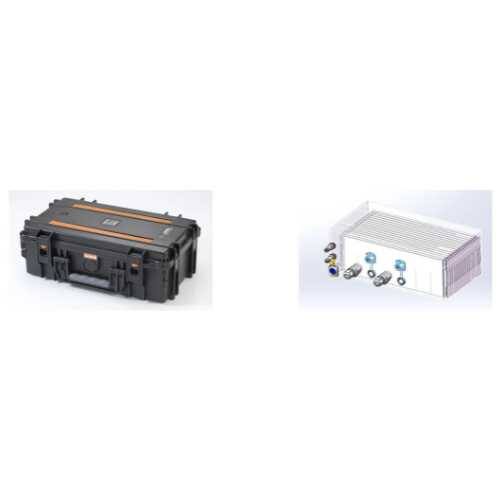
LiFePO4 (LFP) Battery Pack Manufacturer for OEM Equipment
Quick answer: LBC supplies LFP and NMC lithium battery packs, 12V–144V+, with a matched BMS on every pack, for OEMs in the United States, Canada and Mexico. Catalog programs start at 10 units; custom designs at 25. Lead times of weeks to months are confirmed in the quote.
Lithium Battery Company designs and manufactures custom LiFePO4 (lithium iron phosphate, LFP) battery packs for OEM equipment. We build LFP packs from 12V auxiliary packs up to high-voltage systems, each with a battery management system (BMS) matched to the load, charger and communications. We've been building lithium packs since 2014, with hundreds of thousands produced for OEM programs.
Catalog LFP packs start at 10 units and custom LFP designs at 25 units. We work with OEM, industrial and commercial programs, business buyers.
Why do OEMs choose LiFePO4?
- Cycle life. LFP tolerates daily deep cycling better than most lithium-ion chemistries, which lowers cost per cycle in equipment that works every day.
- Thermal stability. The iron-phosphate cathode is more stable at high temperature than nickel-based cathodes, which suits enclosed equipment and machines that work near people.
- Steady voltage. LFP holds a flat voltage through most of the discharge, so equipment performance doesn't sag as the pack drains.
- No cobalt or nickel in the cathode. That helps cost and material availability.
The trade-off is energy density: LFP packs are heavier and larger than NMC packs of the same energy. When weight or volume is the tighter limit, see NMC battery pack manufacturing or compare both on our LFP vs NMC chemistry page.
Which LFP pack voltages are available?
LiFePO4 cells are 3.2V nominal, with a full charge of about 3.6V per cell, so LFP packs come in multiples of 3.2V:
- 12.8V (4 cells in series): the 12V class. 12V LiFePO4 packs.
- 25.6V (8S): the 24V class. 24V LiFePO4 packs.
- 38.4V (12S): the 36V class. 36V packs.
- 51.2V (16S): the 48V class used in AGVs, material handling, telecom and storage. 48V LiFePO4 packs.
- Higher voltages for electric-drive and energy-storage systems: 72V, 96V and 144V.
We match the full-charge and cut-off voltages to your controller and charger, not just the nominal number.
What does LBC engineer into an LFP pack?
- Cell selection. Cylindrical or prismatic LFP cells chosen for capacity, current, size and cost.
- BMS matched to LFP. Protection limits, balancing and state-of-charge estimation tuned for LFP's flat voltage curve. Because voltage barely changes through the middle of the discharge, state of charge relies on current counting, and the charging routine should allow periodic full charges to recalibrate. See battery management systems.
- Cold-charging protection. LFP must not be charged below freezing without heating or reduced current. The BMS enforces this, and we add heating where the equipment charges in the cold.
- Current paths and fusing sized for your continuous and peak loads.
- Thermal and mechanical design for the enclosure, vibration and environment your equipment sees.
- Charger matching. A charge profile for LFP, without the equalization stages lead-acid chargers use. See our charger catalog.
Where our LFP packs are used
- AGV, AMR and mobile robot battery packs
- Telecom backup battery packs
- Commercial energy storage battery packs
- Industrial lithium battery packs and forklift lithium battery packs
- Lead-acid to LFP replacement in equipment designed around lead-acid. Read LiFePO4 vs lead-acid for industrial equipment.
From prototype to volume production
Every program follows the same path: requirements, pack design with drawings and a BOM you approve, prototype builds tested against an agreed validation plan, then pilot and volume production with inspection points, end-of-line test records and change control. Lead times run from weeks to months depending on cells, design scope and validation, and your quote confirms them. See custom battery pack manufacturer and prototype to production.
What to send for an LFP battery quote
Equipment and application, voltage window, continuous and peak current, runtime or capacity, charger, maximum dimensions and weight, operating and charging temperature, communications, compliance and transport requirements, first-order quantity and annual volume. Get a Quote.
Frequently asked questions
Do you manufacture custom LiFePO4 battery packs?
Yes. We design and manufacture custom LiFePO4 (LFP) battery packs for OEM equipment, from 12V packs up to high-voltage systems, each with a matched BMS.
What voltages do LiFePO4 battery packs come in?
LFP cells are 3.2V nominal, so common packs are 12.8V (4S), 25.6V (8S), 38.4V (12S) and 51.2V (16S), with higher voltages for electric-drive and energy-storage systems.
Is LiFePO4 better than NMC?
It depends on the equipment. LFP offers longer cycle life and better thermal stability; NMC offers more energy per kilogram. We recommend one from your load, runtime, weight, temperature and cost targets.
Can LiFePO4 batteries be charged below freezing?
Not without precautions. LFP must not be charged below freezing without heating or reduced current, so the BMS blocks or limits cold charging and we add heating where needed.
What is the minimum order for LFP battery packs?
Catalog LFP packs start at 10 units. Custom LFP designs and modified catalog packs start at 25 units.