
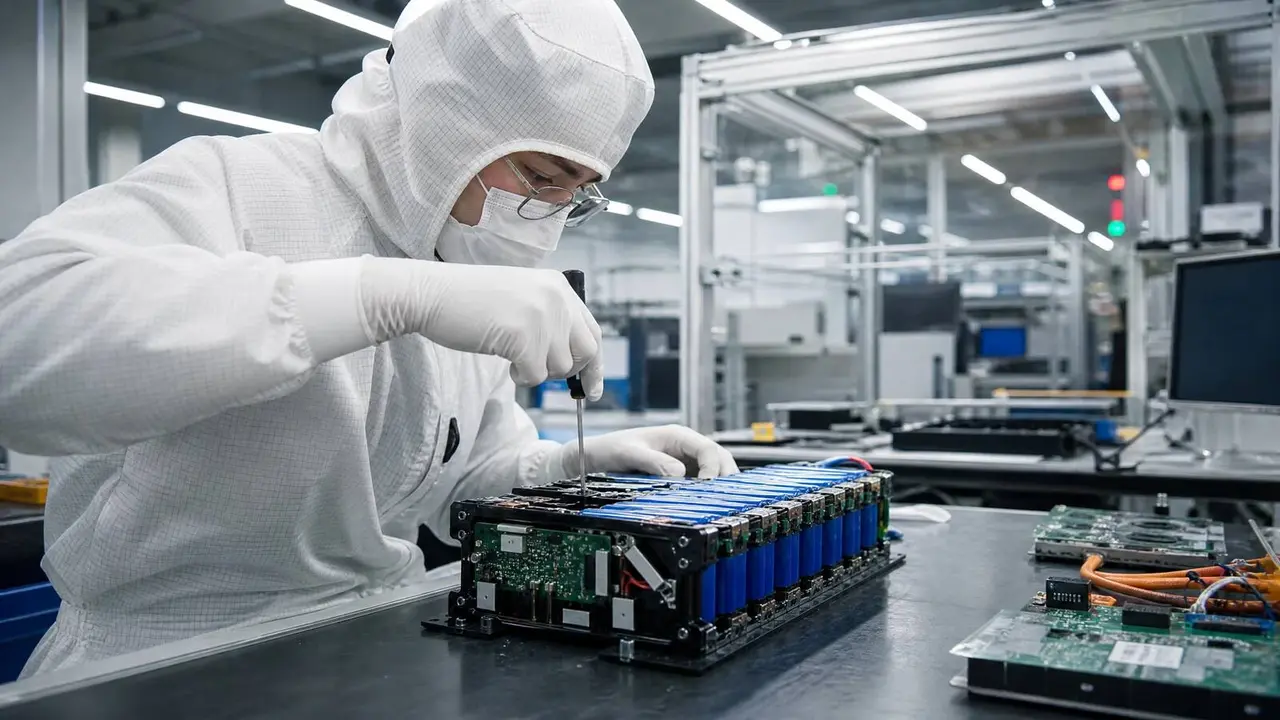
A custom OEM battery pack manufacturer designs, engineers, and produces lithium battery packs to your exact specifications — voltage, capacity, chemistry, form factor, BMS, certifications, and volume. The right manufacturer is a long-term engineering partner, not a catalog supplier. The wrong one is a single point of failure in your product program.
This guide covers everything an OEM engineer or procurement manager needs to evaluate a battery pack manufacturer: capabilities, certifications, minimum order quantities, lead times, and the questions that separate real manufacturers from distributors posing as manufacturers.
What Is a Custom OEM Battery Pack?
A custom OEM battery pack is a lithium battery pack designed and manufactured to a specific OEM's requirements rather than sold as a standard catalog product. Custom OEM packs typically involve:
- Custom voltage — any series configuration of cells to achieve the required pack voltage
- Custom capacity — any parallel configuration to achieve the required amp-hour rating
- Custom form factor — enclosure dimensions, connector type, and mounting interface designed to fit the OEM's product
- Custom BMS — Battery Management System programmed with the OEM's specific charge/discharge parameters, communication protocol (CAN, SMBus, I2C, RS-485), and protection thresholds
- Custom certifications — UL, IEC, MIL-STD, DO-160, or other certifications required by the OEM's end market
How to Evaluate a Custom OEM Battery Pack Manufacturer
1. Do They Actually Manufacture, or Do They Resell?
This is the most important question. Many companies that present themselves as battery pack manufacturers are actually distributors or assemblers sourcing packs from overseas factories. A real manufacturer owns the production equipment, employs the engineers, and controls the manufacturing process.
Ask directly: Where is the pack manufactured? What production equipment do you own? Can we visit the facility? A manufacturer with nothing to hide will answer these questions immediately.
2. What Is Their Engineering Capability?
Custom OEM programs require real engineering — cell selection, S×P configuration calculation, BMS specification, thermal modeling, enclosure design, and certification test preparation. Ask to speak with an application engineer before placing any order. If the sales process never involves an engineer, that is a red flag.
3. What Certifications Can They Support?
Your end market dictates your certification requirements. Defense programs require MIL-STD-810 and often MIL-PRF-32565. Aviation requires DO-160. Medical requires IEC 62133 and often UL 2054. Consumer products require UN 38.3 for shipping. Industrial OEM typically requires UL 2054 or IEC 62133.
A manufacturer who cannot support your required certifications is not a viable partner for your program, regardless of price.
4. What Is Their Minimum Order Quantity?
MOQ varies widely. Some manufacturers require 500+ units for custom work. Others — including Lithium Battery Company — accept custom configurations starting at 25 units, with catalog designs available from 10 units. For programs in the prototype or early production phase, MOQ flexibility is critical.
5. What Is Their Production Capacity?
A manufacturer who can produce 1,000 units per year cannot support a program that scales to 50,000 units. Verify production capacity before committing to a long-term partnership. Ask about their current utilization, expansion plans, and how they handle demand spikes.
What to Include in a Battery Pack RFQ
A well-structured RFQ accelerates the quoting process and ensures you receive comparable quotes from multiple manufacturers. Include:
| RFQ Element | Details to Specify | |---|---| | Nominal voltage | e.g., 48V nominal | | Capacity | e.g., 100Ah | | Chemistry | LFP or NMC | | Cell format | Prismatic, cylindrical, or pouch | | Peak discharge current | e.g., 200A peak, 100A continuous | | Charge current | e.g., 50A max charge rate | | Operating temperature | e.g., -20°C to +55°C | | Enclosure dimensions | L × W × H in mm | | Connector type | e.g., Anderson SB175, XT90, custom | | BMS communication | CAN, SMBus, RS-485, or none | | Certifications required | UL, IEC, MIL-STD, DO-160, etc. | | Annual volume | Units per year at full production | | Prototype quantity | Units needed for testing |
US-Based vs Overseas OEM Battery Pack Manufacturing
The decision between a US-based and overseas battery pack manufacturer involves tradeoffs that go beyond unit price.
US-based advantages: Shorter lead times (weeks vs months), direct engineering collaboration without time-zone delays, IP protection under US law, NDAA Section 889 compliance for defense programs, Buy American Act eligibility, and supply chain security for programs that cannot tolerate foreign dependencies.
Overseas advantages: Lower unit cost at high volumes, established cell supply relationships with Asian cell manufacturers.
For defense, government, and critical infrastructure programs, US-based manufacturing is often a requirement, not a preference. For commercial OEM programs, the total cost of ownership — including lead time costs, engineering collaboration costs, and supply chain risk — frequently favors domestic manufacturing even when the unit price is higher.
Frequently Asked Questions
Q: What is the minimum order quantity for a custom OEM battery pack? At Lithium Battery Company, custom OEM battery pack configurations start at 25 units. Catalog designs are available from 10 units. Volume pricing tiers begin at 100 units, with annual volume pricing for programs requiring 1,000+ units per year. Production capacity is confirmed program by program with the selected qualified partner.
Q: How long does it take to develop a custom OEM battery pack? A simple custom configuration — standard chemistry, standard cell format, custom voltage/capacity — typically takes 4–8 weeks from engineering kickoff to first article samples. Complex programs involving custom enclosures, certifications, or new BMS development take 12–24 weeks. Contact our engineering team with your requirements for a specific timeline estimate.
Q: What certifications does Lithium Battery Company support? We support UL 2054, IEC 62133, UN 38.3, CE Marking, RoHS, REACH, MIL-STD-810, MIL-PRF-32565, DO-160, NDAA Section 889, Buy American Act, and DOT 49 CFR / IATA DGR for shipping.
Q: Can Lithium Battery Company manufacture NDAA-compliant battery packs? Yes. Lithium Battery Company battery packs are NDAA Section 889 compliant. We are a US-based manufacturer with domestic production capability, which satisfies the domestic content requirements for most defense and government procurement programs.