

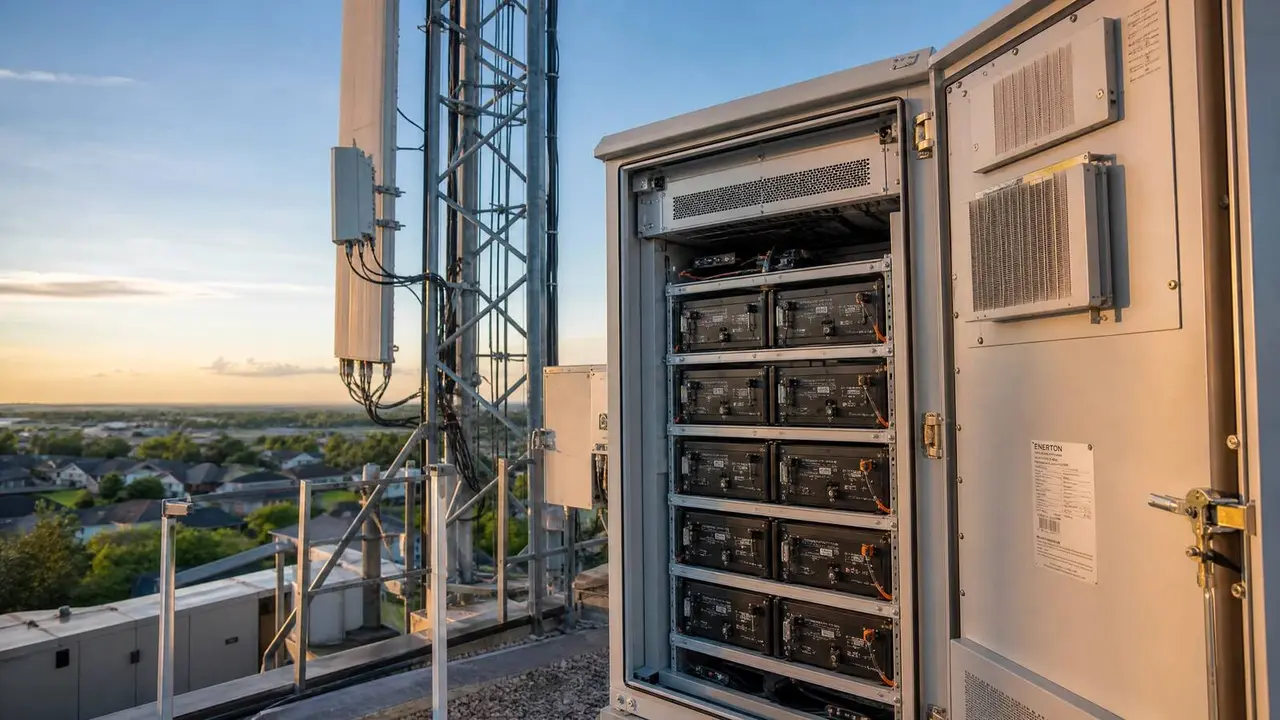
LFP (Lithium Iron Phosphate) battery packs are a direct drop-in replacement for VRLA (Valve-Regulated Lead-Acid) batteries at cell towers, data centers, and telecom infrastructure — delivering 5–10x the cycle life, 50–70% weight reduction, and a 10–15 year service life versus 3–5 years for lead-acid. The economics are compelling even at a higher upfront cost.
This guide covers everything telecom operators, tower companies, and infrastructure managers need to know about replacing VRLA lead-acid with LFP lithium backup batteries.
Why Telecom Infrastructure Uses Backup Batteries
Cell towers, data centers, and telecom switching facilities require uninterruptible power to maintain service during grid outages. The standard backup power architecture uses a rectifier to charge a battery string, which then powers the DC load (typically -48V for telecom) during outages. The battery must deliver enough energy to power the site for a defined backup time — typically 4–8 hours for cell towers, longer for critical infrastructure.
For decades, VRLA lead-acid batteries have been the standard for telecom backup. They are inexpensive, well-understood, and available from many suppliers. But they have significant operational liabilities.
The Problem with VRLA Lead-Acid in Telecom Applications
Short service life: VRLA batteries in telecom applications typically last 3–5 years before capacity degrades below the required backup time. In a network with thousands of sites, battery replacement is a constant, expensive operational burden.
Temperature sensitivity: VRLA battery life is highly sensitive to temperature. Every 10°C above 25°C cuts battery life in half. Cell towers in hot climates — the US South, Middle East, Southeast Asia — experience dramatically shortened VRLA service life.
High maintenance: VRLA batteries require periodic capacity testing, terminal cleaning, and replacement of failed cells. Field technician time for battery maintenance is a significant operational cost.
Weight: VRLA batteries are heavy. A 48V, 100Ah VRLA string weighs 200–300 kg. Tower structures and equipment shelters have weight limits that constrain VRLA capacity.
Why LFP Is the Right Replacement Chemistry
LFP (Lithium Iron Phosphate) addresses every VRLA liability:
| Property | VRLA Lead-Acid | LFP Lithium | |---|---|---| | Service life | 3–5 years | 10–15 years | | Cycle life | 300–500 cycles | 3,000–6,000+ cycles | | Temperature sensitivity | High (life halves per 10°C above 25°C) | Low (stable to 60°C) | | Weight | 200–300 kg per 100Ah at 48V | 60–90 kg per 100Ah at 48V | | Maintenance | High (testing, cleaning, cell replacement) | Low (BMS handles monitoring) | | Depth of discharge | 50% recommended | 80–90% usable | | Thermal runaway risk | Low | Very low |
The 10–15 year LFP service life versus 3–5 years for VRLA means one LFP installation replaces 2–4 VRLA replacement cycles. When total cost of ownership is calculated — including replacement labor, disposal costs, and downtime — LFP is typically less expensive over a 10-year horizon even at 2–3x the upfront cost.
Drop-In LFP Replacement: What "Drop-In" Actually Means
A true drop-in LFP replacement for VRLA uses the same voltage (48V nominal for telecom), the same physical form factor (standard battery cabinet dimensions), and communicates with the existing rectifier using standard protocols (SNMP, Modbus, or dry contact alarms).
Not all LFP batteries marketed as "drop-in" are truly compatible. Key compatibility requirements:
- Voltage compatibility: 48V LFP nominal (51.2V for LFP = 16S configuration) must be compatible with the rectifier's charge voltage range. Most modern telecom rectifiers support LFP charge profiles.
- Float voltage: LFP float voltage (54.4–54.8V for 16S) differs from VRLA float voltage (54.0–54.4V). Verify rectifier programmability.
- BMS communication: The LFP BMS should communicate battery state (SOC, alarms, temperature) to the site monitoring system via the same protocol as the replaced VRLA system.
Frequently Asked Questions
Q: Can LFP batteries replace VRLA lead-acid at cell towers? Yes. LFP (Lithium Iron Phosphate) battery packs are a direct drop-in replacement for VRLA lead-acid batteries at cell towers and telecom infrastructure. LFP delivers 10–15 year service life versus 3–5 years for VRLA, 50–70% weight reduction, and significantly lower total cost of ownership over a 10-year horizon.
Q: What voltage do telecom backup batteries use? Most telecom infrastructure uses -48V DC (nominally 48V). LFP telecom backup batteries use a 16S cell configuration (16 cells in series) for a nominal voltage of 51.2V, which is compatible with standard telecom rectifiers.
Q: How long do LFP telecom batteries last? LFP telecom backup batteries typically last 10–15 years in service, delivering 3,000–6,000+ charge cycles before reaching 80% of original capacity. This is 3–5x the service life of VRLA lead-acid batteries in the same application.
Q: Does Lithium Battery Company manufacture LFP telecom backup batteries? Yes. Lithium Battery Company manages LFP battery programs for telecom backup power applications. Our 48V LFP packs are designed as drop-in replacements for VRLA lead-acid batteries at cell towers, data centers, and telecom switching facilities. Contact our team to discuss your site requirements and backup time specifications.