

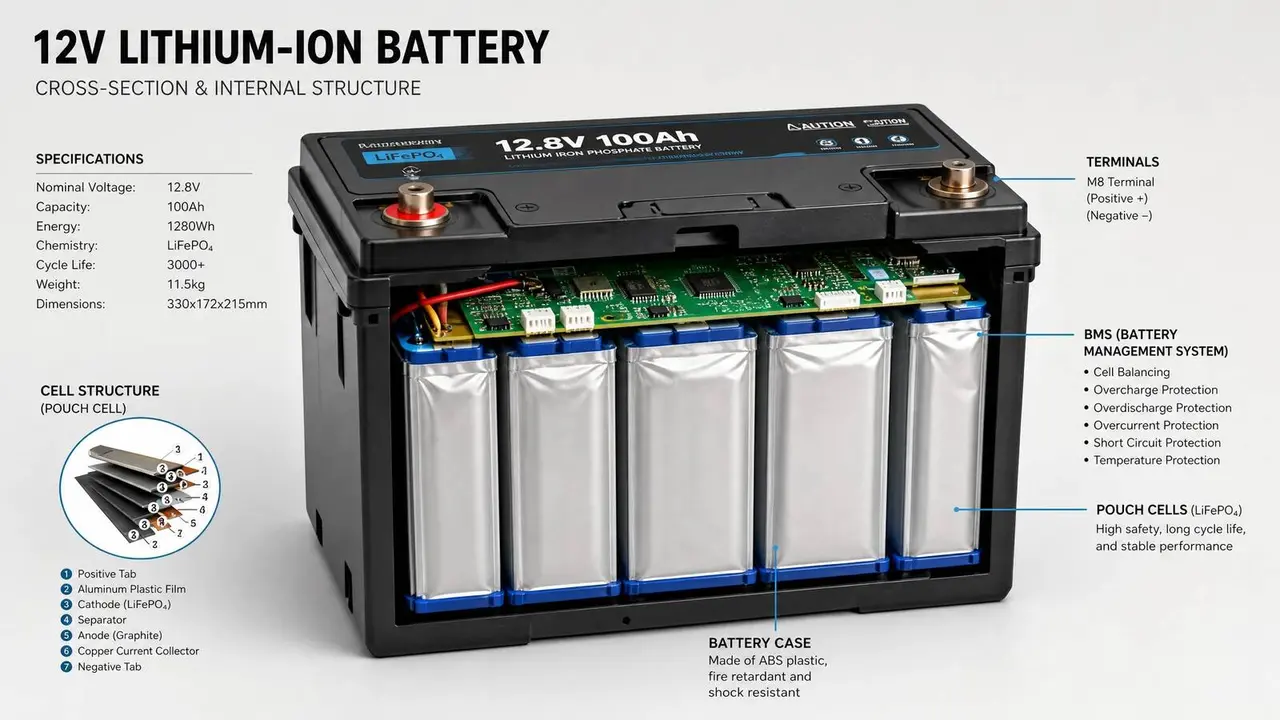
The 12V lithium-ion battery is the most common battery configuration in the world — used in marine, RV, solar, backup power, and countless other applications. Understanding how they work, what the specifications mean, and how to select the right one is essential knowledge for any engineer or buyer.
How 12V Lithium Batteries Work
A 12V lithium battery is a pack of individual lithium-ion cells connected in series and parallel to achieve the desired voltage and capacity.
Series connections increase voltage. LFP cells have a nominal voltage of 3.2V. Four LFP cells in series produce 12.8V — close enough to 12V to be compatible with 12V systems.
Parallel connections increase capacity. Two 100Ah cells in parallel produce a 200Ah pack at the same voltage.
Most 12V lithium packs combine series and parallel connections to achieve the desired voltage and capacity. A 12V 200Ah LFP pack might use 4 cells in series (for 12.8V) and 2 cells in parallel (for 200Ah), for a total of 8 cells.
The Battery Management System
The Battery Management System (BMS) is the electronic brain of the battery pack. It performs several critical functions:
Cell Protection: The BMS monitors each cell's voltage and temperature, disconnecting the pack if any cell exceeds safe limits. This prevents over-charging, over-discharging, and thermal runaway.
Cell Balancing: Over time, cells in a pack can develop slight differences in capacity. The BMS balances the cells by equalizing their state of charge, ensuring the full capacity of the pack is available.
State of Charge Estimation: The BMS calculates and reports the remaining capacity as a percentage, allowing you to monitor how much energy is left.
Communication: Advanced BMS units communicate with external systems via CAN bus, RS485, or Bluetooth, providing real-time data on pack status.
Key Specifications Explained
Nominal Voltage: The average voltage during discharge. For 12V LFP packs, this is typically 12.8V.
Capacity (Ah): The total charge the battery can deliver. A 100Ah battery can deliver 10 amps for 10 hours, or 100 amps for 1 hour (approximately — actual performance varies with discharge rate).
Energy (Wh): Capacity multiplied by voltage. A 12.8V 100Ah battery stores 1,280Wh of energy.
Continuous Discharge Current: The maximum current the battery can deliver continuously without damage. This is determined by the BMS rating, not just the cell capacity.
Peak Discharge Current: The maximum current the battery can deliver for a short period (typically 30 seconds). Important for applications with high startup currents.
Charge Current: The maximum current the battery can accept during charging. Higher charge current means faster charging.
Cycle Life: The number of charge-discharge cycles the battery can complete before reaching 80% of original capacity. LFP batteries typically offer 2,000–5,000 cycles.
Operating Temperature: The temperature range within which the battery can be safely discharged. Most LFP batteries operate from -20°C to +60°C.
Charge Temperature: The temperature range within which the battery can be safely charged. Charging LFP batteries below 0°C can cause lithium plating and permanent damage. Quality BMS units include low-temperature charge cutoff protection.
Charging 12V Lithium Batteries
12V lithium batteries require a charger designed for lithium chemistry. The charge profile differs from lead-acid:
LFP Charge Profile:
- Constant Current (CC) phase: Charge at maximum current until pack reaches 14.4–14.6V
- Constant Voltage (CV) phase: Hold at 14.4–14.6V until current drops to ~0.05C
- No float charging required (LFP does not sulfate)
Using a lead-acid charger on an LFP battery will result in undercharging. The lead-acid absorption voltage (typically 14.4–14.8V) is compatible with LFP, but the float voltage (typically 13.6–13.8V) may cause the BMS to disconnect the pack.
Most modern multi-stage chargers include a dedicated LFP mode. When in doubt, use a charger specifically designed for LFP batteries.
Common Applications
Marine: House banks for sailboats and powerboats. LFP's flat discharge curve, long cycle life, and safety characteristics make it the preferred choice for marine applications.
RV and Van Life: House banks for recreational vehicles. Weight savings versus lead-acid improve fuel economy and handling.
Solar Storage: Paired with solar panels and a charge controller for off-grid power systems. LFP's long cycle life and wide temperature range make it well-suited for outdoor installations.
Backup Power: UPS and emergency backup systems. LFP's long standby life and reliable capacity make it ideal for backup applications.
Industrial Equipment: Forklifts, AGVs, and other industrial equipment where long cycle life and fast charging are important.
Lithium Battery Company supports 12V LFP battery programs for all of these applications and more. Contact us to discuss your requirements.