

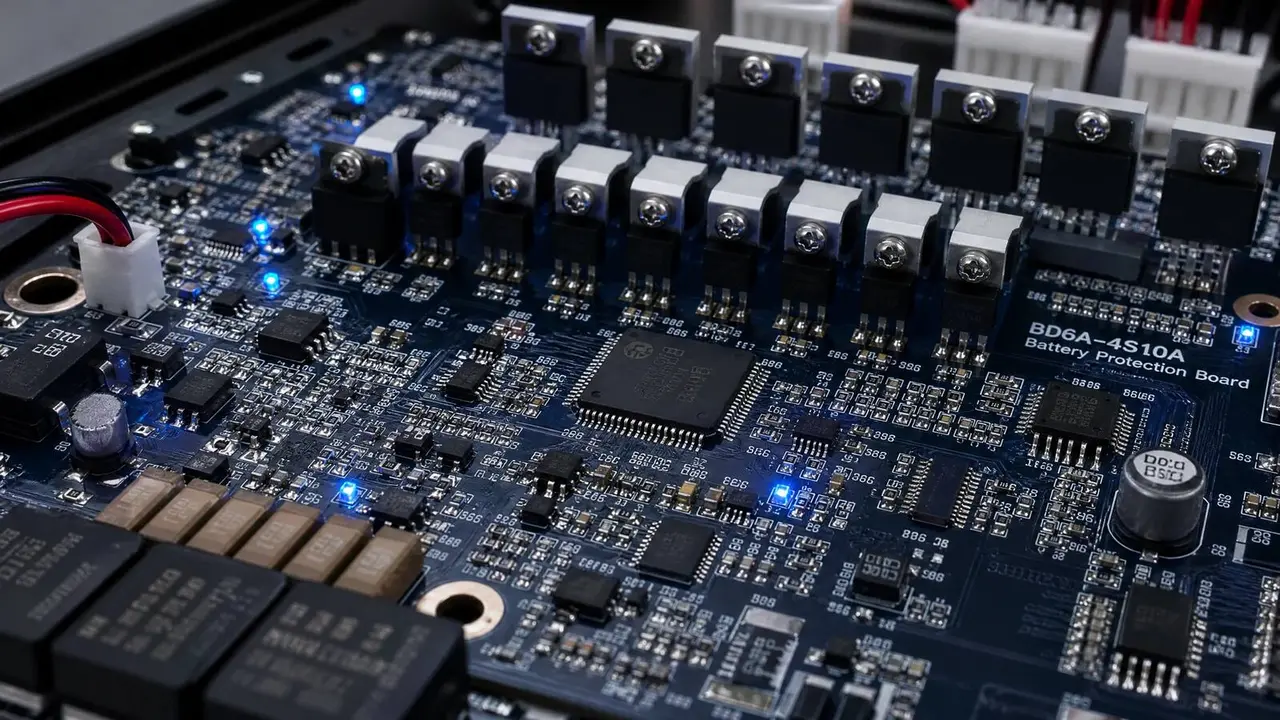
A Battery Management System (BMS) is the electronics package that protects a lithium battery pack from damage, monitors cell health, balances cells during charging, and communicates battery state to the host system. A lithium battery pack without a BMS is dangerous — cells can be overcharged, over-discharged, or driven into thermal runaway without the protection a BMS provides.
Every battery pack from Lithium Battery Company includes a matched BMS. This guide explains what a BMS does, the key specifications to evaluate, and how to specify the right BMS for your OEM application.
What Does a BMS Do?
A BMS performs six core functions:
1. Cell voltage monitoring: The BMS measures the voltage of every individual cell in the pack. Lithium cells must stay within a defined voltage window — typically 2.5V–3.65V for LFP, 2.5V–4.2V for NMC. Cells outside this window can be permanently damaged or enter thermal runaway.
2. Cell balancing: In a multi-cell series string, cells inevitably develop small capacity differences over time. Without balancing, the weakest cell limits the entire pack's capacity. The BMS balances cells by bleeding charge from higher-voltage cells (passive balancing) or transferring charge between cells (active balancing) to equalize voltages.
3. Temperature monitoring: The BMS monitors cell and pack temperature. Lithium batteries must not be charged below 0°C (which causes lithium plating) or operated above their maximum temperature. The BMS cuts off charging or discharging when temperature limits are exceeded.
4. Current monitoring: The BMS measures charge and discharge current. It protects against overcurrent conditions that can damage cells and wiring, and uses current data to calculate state of charge (SOC).
5. State of charge (SOC) estimation: SOC is the battery equivalent of a fuel gauge — it tells the host system how much energy remains. Accurate SOC estimation requires integrating current over time (coulomb counting) and compensating for temperature and aging effects.
6. Protection and fault management: The BMS controls the pack's main contactor or MOSFET switches, disconnecting the pack from the load or charger when a fault condition is detected — overcharge, overdischarge, overcurrent, over-temperature, or short circuit.
Passive vs Active Cell Balancing
Passive balancing dissipates excess charge from higher-voltage cells as heat through resistors. It is simple, inexpensive, and effective for packs with small cell-to-cell variation. The limitation is that it wastes energy and generates heat.
Active balancing transfers charge from higher-voltage cells to lower-voltage cells using inductors or capacitors. It is more efficient than passive balancing and can recover more capacity from an imbalanced pack. Active balancing is preferred for large packs, high-cycle applications, and programs where efficiency is critical.
BMS Communication Protocols
For OEM applications, BMS communication is critical. The BMS must report battery state to the host system — vehicle controller, inverter, building management system, or monitoring platform. Common BMS communication protocols:
| Protocol | Common Applications | |---|---| | CAN bus / CANopen | AGVs, electric vehicles, industrial equipment | | SMBus (I2C) | Laptops, portable electronics, medical devices | | RS-485 / Modbus | Stationary ESS, telecom, industrial equipment | | UART | Simple embedded systems | | Dry contact alarms | Basic fault signaling for UPS and backup systems |
Key BMS Specifications for OEM Programs
When specifying a BMS for an OEM battery pack, the critical parameters are:
- Cell count: Number of series cells the BMS can monitor (must match pack configuration)
- Maximum continuous current: Must exceed the application's maximum discharge current
- Peak current rating: For applications with high inrush or peak current demands
- Balancing current: Higher balancing current reduces balancing time
- Communication protocol: Must match the host system's interface
- Operating temperature range: Must cover the application's temperature range
- Protection thresholds: Overcharge, overdischarge, overcurrent, and over-temperature setpoints
- Can be overcharged, which causes permanent capacity loss and, in severe cases, thermal runaway
- Can be over-discharged, which permanently damages cells and reduces cycle life
- Has no overcurrent protection — a short circuit can cause a fire
- Has no cell balancing — capacity diverges rapidly, reducing effective pack capacity
- Provides no state-of-charge information to the host system
Why Every Pack Needs a BMS — No Exceptions
Some low-cost battery packs are sold without a BMS to reduce cost. This is a false economy. A lithium battery pack without a BMS:
The BMS is not an optional add-on. It is the safety system that makes lithium battery packs safe to use. Every Lithium Battery Company pack includes a matched BMS — it is standard on every configuration, from catalog designs to fully custom packs.
Frequently Asked Questions
Q: What is a BMS in a battery pack? A BMS (Battery Management System) is the electronics package in a lithium battery pack that monitors cell voltages and temperatures, balances cells during charging, protects against overcharge/overdischarge/overcurrent/over-temperature, estimates state of charge, and communicates battery state to the host system. A BMS is required for safe operation of any lithium battery pack.
Q: Does every Lithium Battery Company battery pack include a BMS? Yes. Every battery pack from Lithium Battery Company includes a matched Battery Management System (BMS) with cell balancing, over-current protection, over-temperature protection, short-circuit protection, and state-of-charge estimation. The BMS is standard on every configuration — never an add-on.
Q: What is the difference between passive and active BMS balancing? Passive balancing dissipates excess charge from higher-voltage cells as heat through resistors — simple and inexpensive but wastes energy. Active balancing transfers charge between cells using inductors or capacitors — more efficient and recovers more capacity from imbalanced packs. Active balancing is preferred for large packs and high-cycle applications.
Q: What BMS communication protocols does Lithium Battery Company support? Lithium Battery Company supports CAN bus, CANopen, SMBus, RS-485/Modbus, UART, and dry contact alarm outputs depending on the application. Contact our engineering team to specify the communication protocol required for your host system.