
LBC / Engineering guides
How to size a 24V AGV battery pack: a worked example
Quick answer. To size a 24V AGV battery, multiply the vehicle's average power by the hours it must run between charges, then divide by the usable depth of discharge (often about 80%). Divide that watt-hour figure by the nominal voltage (25.6V for 8S LiFePO4) to get amp-hours. Then check peak current and the charger.
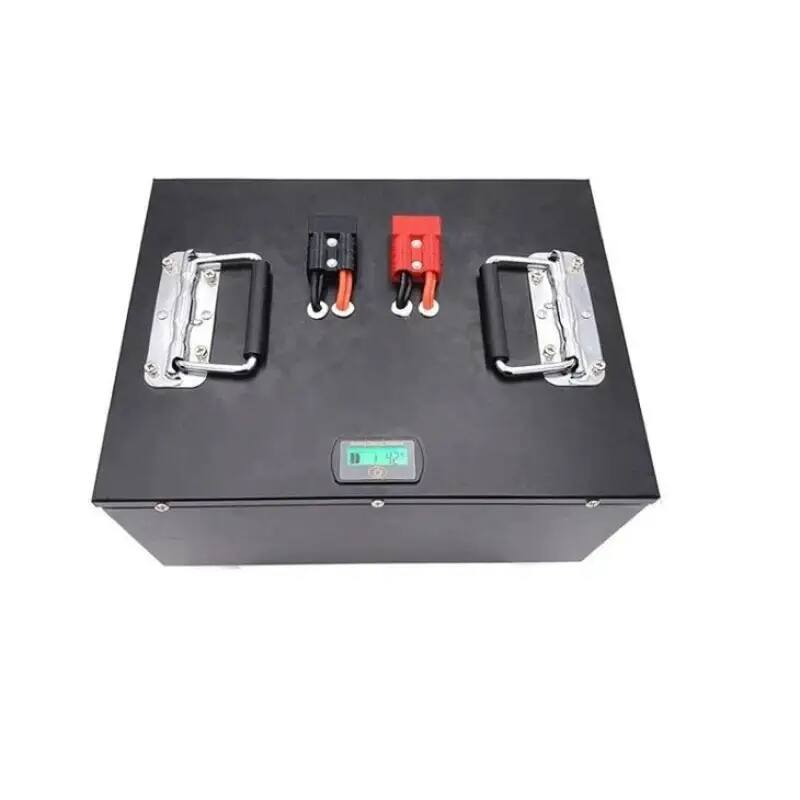
Step 1: Pin down the voltage
A "24V" AGV can mean different packs. An 8-cell LiFePO4 (LFP) pack is 25.6V nominal and 29.2V at full charge. A 7-cell NMC pack is about 25.2–25.9V nominal and 29.4V full. Your drive controller has a minimum and maximum input voltage, and the pack's full-charge and cut-off voltages must both sit inside that window. Start there, and keep the chemistry fixed once you choose it, because the charger profile depends on it. More on cell counts: 12.8V, 25.6V and 51.2V explained.
Step 2: Find average power, not peak
Measure or estimate the vehicle's average power draw over a real duty cycle: driving, idling, lifting or conveyor work, onboard computers, lidar and wireless. A logged current trace from a prototype is best. If you only have component ratings, add them up for each mode and weight each by the share of time spent in it.
Step 3: Watt-hours between charges
Energy needed = average power × hours between charges.
The key word is between charges. A vehicle that opportunity-charges at a dock every two hours needs far less battery than one that must run a full shift. See opportunity charging for AGVs.
Step 4: Add margin for usable depth of discharge, ageing and cold
Don't plan to use 100% of rated capacity. A common planning figure is about 80% usable depth of discharge, which leaves reserve for the return trip to the charger, for capacity loss as the pack ages, and for colder floors. Your own number depends on your warranty target and duty cycle.
Required rated energy = energy needed ÷ usable fraction.
Rated amp-hours = required rated energy ÷ nominal voltage.
Step 5: Check current (what "25A" means on an AGV spec)
When an AGV spec says "25A", it is usually the continuous discharge current the pack and its BMS must deliver. Check two numbers:
- Continuous current at your heaviest sustained load (full payload, ramp, or lift).
- Peak current and how long it lasts, for acceleration and starting a lift.
The cells, BMS over-current limit, fuse, wiring and connector all have to carry both. A pack sized only for energy can still trip under a peak it wasn't built for. If regenerative braking pushes current back into the pack, the BMS charge-current limit matters too.
Worked example (illustrative numbers)
Say a 25.6V LiFePO4 AMR averages 400 W over its duty cycle and has to run 10 hours between charges.
- Energy needed: 400 W × 10 h = 4,000 Wh.
- Rated energy at 80% usable: 4,000 ÷ 0.8 = 5,000 Wh.
- Rated capacity: 5,000 Wh ÷ 25.6V ≈ 195 Ah.
That points to a 200Ah-class 24V pack, such as LBC24200-1 (25.6V, 200Ah, 5,120 Wh).
Now say the same AMR can opportunity-charge, so it never runs more than 4 hours between charges:
- 400 W × 4 h = 1,600 Wh.
- 1,600 ÷ 0.8 = 2,000 Wh.
- 2,000 ÷ 25.6V ≈ 78 Ah.
That points to a 75–100Ah-class pack such as LBC2475 or, with more reserve, LBC24120 (25.6V, 120Ah, 3,072 Wh). The trade-off is a charger and dock sized to put that energy back during the breaks.
A "2,155 Wh" AGV pack, for reference, is about 84Ah at 25.6V. If you see a watt-hour figure in a spec, divide by the nominal voltage to compare packs on the same basis.
Step 6: Match the charger
An 8S LiFePO4 pack charges to 29.2V. Pick charger current from the energy you need to put back and the time the vehicle spends on the charger, then confirm it against the BMS charge-current limit and the dock contacts. LBC's catalog lists LFP 8S 29.2V chargers from 7A to 28A, for example the Rugged-Core LFP 8S 29.2V 7A and Industrial-Core LFP 8S 29.2V 28A.
Step 7: Define the BMS interface
Fleet software usually needs state of charge, faults and current limits from the pack. Decide early whether the vehicle talks CANbus, RS485 or SMBus, and which data it needs. See battery management systems.
What to send for a 24V AGV battery quote
Voltage window, chemistry preference, average and peak current (or a current log), hours between charges, charging method and dock, envelope and mounting, connector, communications, operating temperature, first-order quantity and annual volume. Compare options on the 24V AGV battery packs page; catalog programs start at 10 units and custom designs at 25.
Request an OEM battery quote
Frequently asked questions
How many amp-hours does a 24V AGV battery need?
Divide the energy needed between charges by the usable depth of discharge, then by the nominal voltage. For example, 400 W for 10 hours at 80% usable on a 25.6V pack needs about 195Ah.
What does 25A mean on an AGV battery?
It usually means the continuous discharge current the pack and BMS must deliver. Check the peak current and its duration separately, because the BMS, fuse, wiring and connector must carry both.
Is a 24V AGV battery 24V or 25.6V?
Both labels are used. An 8-cell LiFePO4 pack is 25.6V nominal and 29.2V at full charge; a 7-cell NMC pack is about 25.2–25.9V nominal. The controller's voltage window decides which fits.