

> Current operating model: Lithium Battery Company is a US-based battery engineering and sourcing partner. Current customer programs use qualified production partners selected for the battery, volume, quality, and compliance requirements. LBC's planned Tampa manufacturing operation is not yet commissioned. Compliance and country-of-origin claims are confirmed only for a specific bill of materials, production path, and contract.
The best battery pack for a UAV or drone is a high C-rate NMC (Nickel Manganese Cobalt) pack with the highest energy density achievable within the weight and volume envelope of the airframe. Every gram of battery weight directly reduces payload capacity and flight time — chemistry and pack design are mission-critical engineering decisions.
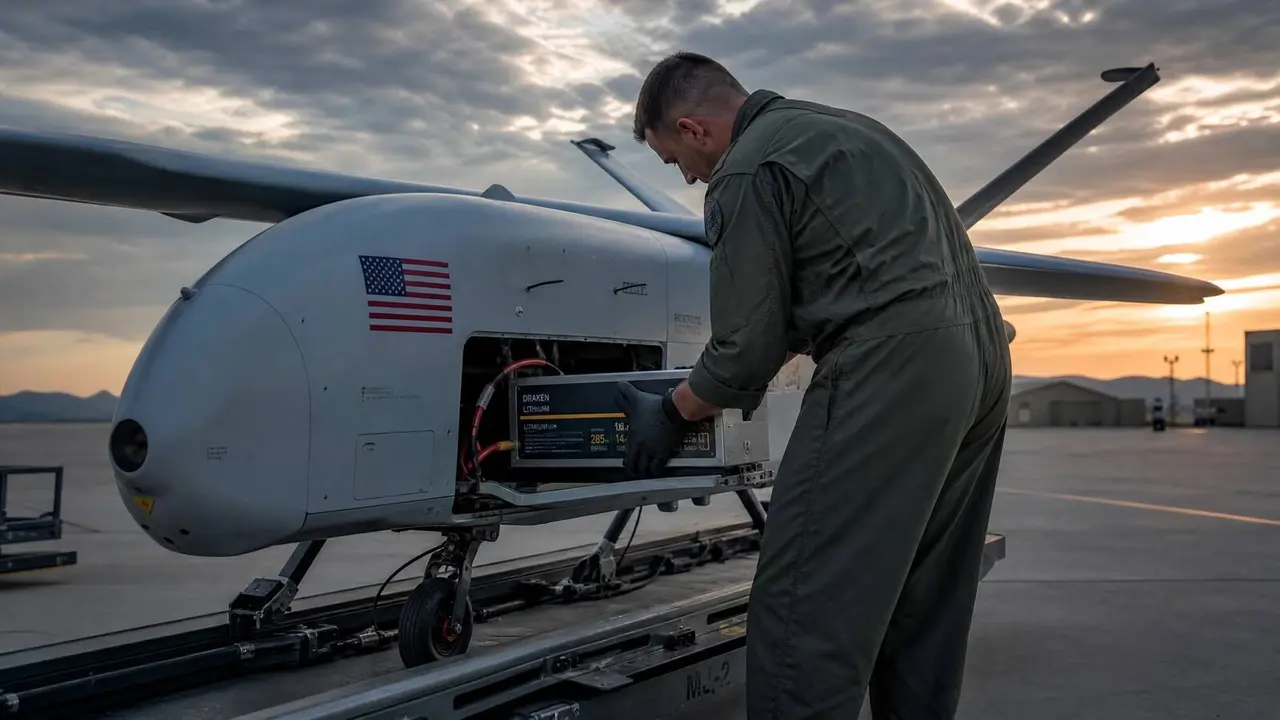
Lithium Battery Company manages custom NMC battery programs for commercial and military UAV programs through qualified production partners managed from Tampa, Florida. This guide covers every technical requirement for drone battery pack design.
What Is C-Rate and Why Does It Matter for Drones?
C-rate is the rate at which a battery is discharged relative to its capacity. A 1C discharge rate means the battery is fully discharged in one hour. A 10C discharge rate means the battery is fully discharged in 6 minutes.
UAV motors draw very high current during takeoff and aggressive maneuvers. A 10Ah battery pack powering motors that draw 100A is operating at 10C. Most consumer drone batteries are rated for 25–50C continuous discharge. Military and high-performance commercial drones may require 75–100C peak discharge capability.
A battery pack that cannot deliver the required C-rate will sag in voltage under load, reducing motor performance and potentially triggering the BMS low-voltage cutoff mid-flight.
NMC vs LFP for UAV Applications
NMC is the correct chemistry for virtually all UAV applications. The energy density advantage is decisive:
| Chemistry | Energy Density | Weight for 1 kWh | |---|---|---| | NMC | 150–250 Wh/kg | 4.0–6.7 kg | | LFP | 90–160 Wh/kg | 6.3–11.1 kg |
For a drone with a 1 kWh battery requirement, NMC can save 2–5 kg compared to LFP. On a 10 kg drone, that is 20–50% of total takeoff weight — a difference that translates directly into payload capacity and flight time.
The only scenario where LFP is appropriate for UAV applications is when the drone operates in extreme temperature environments where LFP's superior thermal stability outweighs the energy density penalty, or when the drone is large enough that the weight difference is insignificant.
Key Design Parameters for UAV Battery Packs
Cell format: Cylindrical cells (18650, 21700) offer the best energy density and are the standard for high-performance UAV packs. Pouch cells offer the highest gravimetric energy density but are more fragile. Prismatic cells are rarely used in UAV applications due to their weight penalty.
Voltage: Most commercial drones operate at 22.2V (6S), 25.9V (7S), or 44.4V (12S). Military drones may use higher voltages. The voltage determines the number of cells in series and directly affects motor KV rating selection.
Capacity: Capacity determines flight time. More capacity means more weight. The optimal capacity is the point where the marginal flight time gained from additional capacity is offset by the weight penalty. This calculation is specific to each airframe and mission profile.
BMS requirements: UAV BMS must be lightweight, support high discharge rates without current limiting, provide accurate state-of-charge estimation, and protect against cell-level failures without triggering false cutoffs during high-current maneuvers.
Military UAV Battery Pack Requirements
Military drone programs add requirements beyond commercial UAV packs:
- MIL-STD-810 environmental testing for temperature, vibration, shock, humidity, and altitude
- NDAA Section 889 compliance — no prohibited Chinese components
- Rapid field swap capability — packs must be swappable in the field without tools
- Wide temperature range — operation from -40°C to +71°C for many military applications
- EMI/RFI shielding — BMS electronics must not interfere with drone communications systems
Frequently Asked Questions
Q: What is the best battery chemistry for a UAV or drone? NMC (Nickel Manganese Cobalt) is the best chemistry for most UAV and drone applications because it delivers the highest energy density — 150–250 Wh/kg — which minimizes pack weight for a given energy requirement. Every gram saved in battery weight increases payload capacity and flight time.
Q: What C-rate do UAV battery packs need? Most commercial UAV battery packs require 25–50C continuous discharge capability. High-performance and military drones may require 75–100C peak discharge. The required C-rate is determined by the maximum motor current draw divided by the pack capacity in amp-hours.
Q: Can Lithium Battery Company manufacture custom UAV battery packs? Yes. Lithium Battery Company manages custom NMC battery programs for UAV and drone programs. We support custom voltages, capacities, cell formats, and BMS configurations. Military UAV programs can be certified to MIL-STD-810 and NDAA Section 889 compliant. Contact our engineering team with your airframe specifications and mission requirements.
Q: What is the minimum order quantity for custom UAV battery packs? Custom UAV battery pack configurations start at 25 units at Lithium Battery Company. Volume pricing tiers begin at 100 units.