
> Current operating model: Lithium Battery Company is a US-based battery engineering and sourcing partner. Current customer programs use qualified production partners selected for the battery, volume, quality, and compliance requirements. LBC's planned Tampa manufacturing operation is not yet commissioned. Compliance and country-of-origin claims are confirmed only for a specific bill of materials, production path, and contract.
A defense-grade battery pack must meet MIL-STD-810 environmental testing, be NDAA Section 889 compliant (no prohibited Chinese components), and in many programs satisfy Buy American Act domestic content requirements. These are not optional certifications — they are procurement requirements that determine whether a supplier can bid on the contract.
Lithium Battery Company supports battery programs for defense and military applications through qualified production partners managed from Tampa, Florida. This guide covers every requirement defense procurement teams and prime contractors need to understand when sourcing battery packs for military programs.
What Is MIL-STD-810?
MIL-STD-810 is the US Department of Defense environmental engineering standard. It defines test methods for verifying that equipment can withstand the environmental conditions encountered in military service — temperature extremes, humidity, altitude, vibration, shock, rain, sand, dust, and more.
A battery pack certified to MIL-STD-810 has been tested and verified to operate reliably under these conditions. The specific test methods required depend on the application:
| MIL-STD-810 Method | What It Tests | |---|---| | Method 501 — High Temperature | Operation and storage at elevated temperatures | | Method 502 — Low Temperature | Operation and storage at sub-zero temperatures | | Method 514 — Vibration | Resistance to vibration from vehicles, aircraft, and equipment | | Method 516 — Shock | Resistance to mechanical shock from drops and impacts | | Method 510 — Sand and Dust | Operation in desert and dusty environments | | Method 506 — Rain | Operation in rain and water exposure | | Method 500 — Low Pressure (Altitude) | Operation at high altitude |
What Is NDAA Section 889?
The National Defense Authorization Act (NDAA) Section 889 prohibits the US government and its contractors from procuring or using telecommunications and video surveillance equipment from specific Chinese companies — including Huawei, ZTE, Hytera, Hikvision, and Dahua — and their subsidiaries and affiliates.
For battery pack procurement, NDAA Section 889 compliance means the battery pack and its components (including BMS electronics) do not contain prohibited components from these entities. Lithium Battery Company battery packs are NDAA Section 889 compliant.
What Is MIL-PRF-32565?
MIL-PRF-32565 is the US military performance specification for rechargeable lithium-ion batteries used in military applications. It establishes performance, safety, and reliability requirements for military-grade lithium-ion cells and battery packs, including specific requirements for:
- Cell chemistry and construction
- Capacity and energy density minimums
- Cycle life requirements
- Safety testing (overcharge, overdischarge, short circuit, crush, nail penetration)
- Environmental testing per MIL-STD-810
- Electromagnetic compatibility per MIL-STD-461
Buy American Act and Domestic Content Requirements
The Buy American Act (BAA) requires that products purchased by the US federal government be manufactured in the United States and contain a minimum percentage of US-sourced components. For battery packs, this means the pack must be assembled in the US and a defined percentage of the component cost must originate from US sources.
Lithium Battery Company is a US-based battery engineering and sourcing partner with domestic assembly capability. LBC's planned Tampa manufacturing operation is not yet commissioned and must not be used as the basis for a current domestic-content claim. We work with defense procurement teams to document domestic content percentages for BAA compliance submissions.
Battery Chemistry for Defense Applications
LFP for ground systems and soldier power: LFP (Lithium Iron Phosphate) is the preferred chemistry for most ground-based defense applications. Its thermal stability — LFP cells are generally more thermally stable than many NMC formulations, but still require appropriate design and protection under abuse conditions — is a critical safety requirement for soldier-worn systems and vehicle-mounted batteries. LFP's 3,000–6,000 cycle life also reduces logistics burden in deployed environments.
NMC for UAV and airborne systems: NMC (Nickel Manganese Cobalt) is preferred for UAV, drone, and airborne applications where energy density is the primary constraint. A lighter battery pack directly increases payload capacity and mission endurance. NMC delivers 150–250 Wh/kg versus LFP's 90–160 Wh/kg.
Key Defense Battery Pack Applications
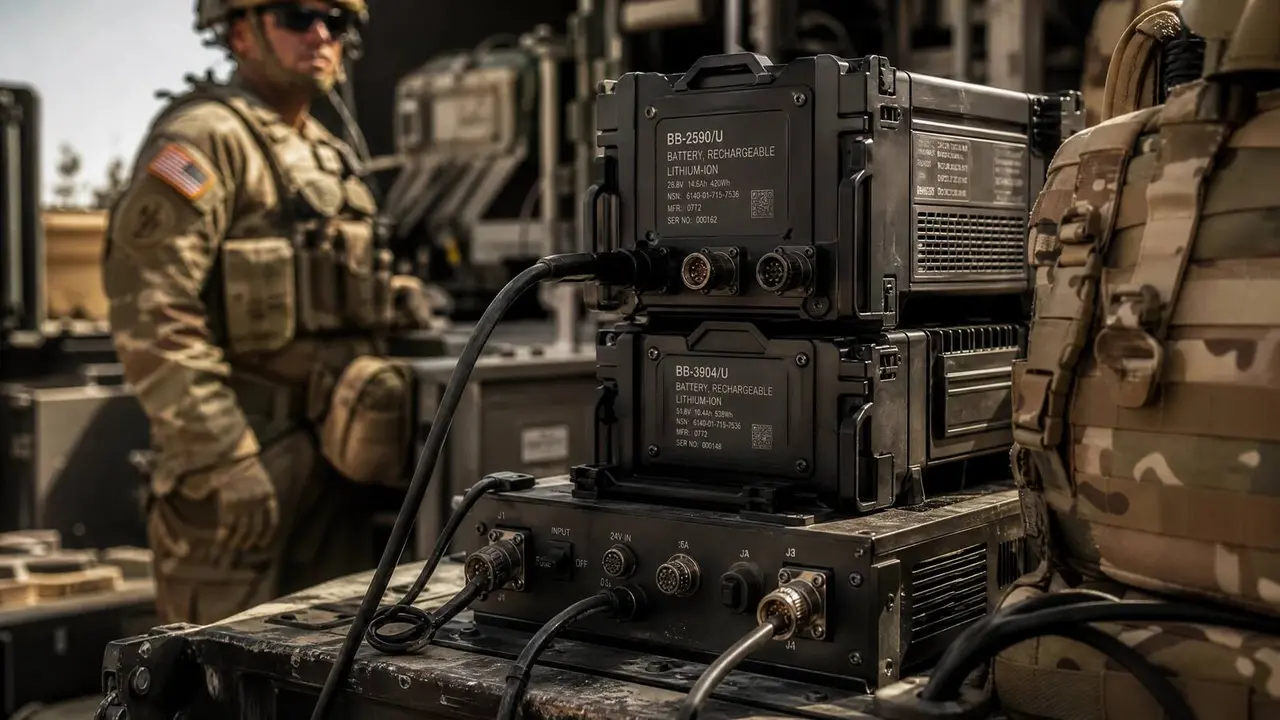
Soldier power systems require lightweight, high-energy-density packs that can power radios, night vision, and computing equipment for 24–72 hours in the field. These packs must survive drops, temperature extremes, and field charging from vehicle power systems.
Ground vehicle batteries power auxiliary systems in tactical vehicles — communications, computing, sensors, and electric drive systems. These packs require high cycle life, wide temperature range operation, and vibration resistance.
Tactical communications — man-portable radios, satellite terminals, and command post equipment — require packs that deliver consistent power across temperature extremes and can be rapidly swapped in the field.
UAV and drone programs require high C-rate NMC packs optimized for maximum flight time and minimum weight. Military UAV batteries must also meet MIL-STD-810 shock and vibration requirements.
Frequently Asked Questions
Q: What certifications are required for defense battery packs? Defense battery packs typically require MIL-STD-810 environmental testing, NDAA Section 889 compliance, and for many programs MIL-PRF-32565 performance compliance. Programs with airborne components may also require DO-160. All defense battery packs require UN 38.3 certification for transportation.
Q: Is Lithium Battery Company NDAA Section 889 compliant? Yes. Lithium Battery Company is a US-based battery engineering and sourcing partner and NDAA and source restrictions are evaluated against each program's current bill of materials and production path. We do not use components from the prohibited entities listed in NDAA Section 889.
Q: Can Lithium Battery Company support Buy American Act procurement? Yes. Current battery programs use qualified production partners; manufacturing origin is documented for the selected program. We work with defense procurement teams to document domestic content percentages for Buy American Act compliance submissions.
Q: What is the difference between MIL-STD-810 and MIL-PRF-32565? MIL-STD-810 is an environmental test standard — it defines how to test equipment for temperature, vibration, shock, humidity, and other environmental conditions. MIL-PRF-32565 is a performance specification for military lithium-ion batteries — it defines what the battery must do (capacity, cycle life, safety) in addition to passing MIL-STD-810 environmental tests.