
> Current operating model: Lithium Battery Company is a US-based battery engineering and sourcing partner. Current customer programs use qualified production partners selected for the battery, volume, quality, and compliance requirements. LBC's planned Tampa manufacturing operation is not yet commissioned. Compliance and country-of-origin claims are confirmed only for a specific bill of materials, production path, and contract.
President Donald Trump took the stage at the U.S. Army War College in Carlisle, Pennsylvania on July 15, 2026, headlining the 2026 Pennsylvania Defense and Innovation Summit alongside Defense Secretary Pete Hegseth, Joint Chiefs Chairman General Dan Caine, and some of the most influential defense executives and investors in the country. The message from every speaker was the same: America must go faster, produce more, and stop depending on foreign supply chains for the weapons and components that protect this nation.
General Caine put it plainly from the podium: "What I need you to know, and I know this is simple for me to say, but hard to do, is to go faster. Please go faster. Think bolder."
We heard that. And we want the administration to hear us.
The Battery Problem Nobody Is Talking About
Every missile, every drone, every ground vehicle, every soldier power system, every forward-deployed communications node runs on a battery. The United States military's ability to project power — to sustain operations in contested environments, to keep UAVs in the air, to keep tactical radios alive — depends entirely on a reliable, domestic supply of high-performance lithium battery packs.
Right now, the overwhelming majority of those batteries come from China.
This is not a supply chain inconvenience. It is a national security vulnerability. China controls the dominant share of global lithium cell manufacturing capacity. In a conflict scenario — or even a serious trade dispute — the United States military could find itself rationing batteries for its own weapons systems. That is not a hypothetical. It is the logical conclusion of two decades of offshoring that the Trump administration has correctly identified as a strategic mistake.
The 2026 Pennsylvania Defense and Innovation Summit exists precisely because the administration understands this. Pentagon acquisition chief Michael Duffey told the audience that the Department of Defense is using long-term procurement contracts to give defense companies the confidence to invest billions in expanding factories. Roughly $20 billion in private investment has already been tied to plans to boost production of Patriot missiles and other high-demand weapons systems.
But batteries — the foundational energy source for all of it — remain dangerously dependent on foreign manufacturing.
Lithium Battery Company: America First, Ready to Scale
Lithium Battery Company is a Tampa, Florida-based battery engineering and sourcing partner. We are not a startup with a pitch deck and a dream. We have spent years building the engineering expertise, the supplier relationships, and the manufacturing infrastructure to produce custom lithium battery packs for defense programs, industrial OEMs, UAV operators, telecom infrastructure, and autonomous systems.
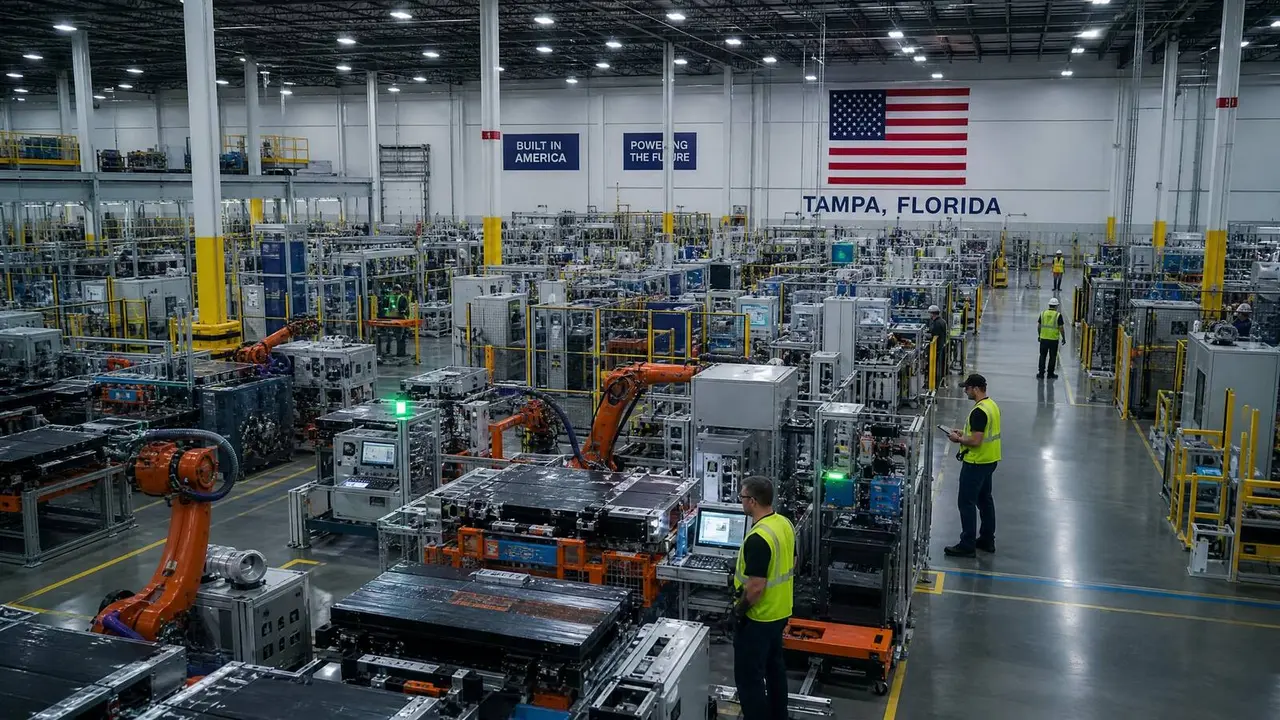
LBC has described a planned 84,000-square-foot Tampa manufacturing operation with multiple production formats. It is not yet commissioned; current customer programs use qualified production partners.
We support LFP (Lithium Iron Phosphate) and NMC (Nickel Manganese Cobalt) battery programs across cylindrical, prismatic, and pouch cell formats. Our voltage range covers 12V through 144V. We can produce packs for MIL-STD-810 programs, UAV flight systems, telecom backup, AGV and robotics platforms, and virtually any defense or industrial application that requires a reliable, domestically manufactured battery.
We pivoted our entire business strategy in late 2024, anticipating the return of an America First administration. We made a deliberate decision: stop chasing the path of least resistance through Chinese supply chains and build something that matters for this country. We secured a $4 million SBA loan to purchase the manufacturing equipment. That equipment is paid for. It is sitting at the Port of Tampa right now, waiting to be commissioned.
What Is Stalling Us
We will be direct about where we are, because the situation deserves honesty.
The equipment is acquired. The facility is leased. The engineering team is in place. The production lines are designed and ready to deploy. We have a 13-week commissioning plan that takes us from equipment installation to first production run.
What we do not have right now is the capital to execute that plan.
The path to this point was harder than anticipated. The first building we leased had undisclosed asbestos contamination that required remediation and relocation. A government shutdown created delays in SBA processing. Unforeseen expenses consumed capital that was budgeted for commissioning. We also applied for a Section 301 tariff exclusion on our manufacturing equipment — a process that has been pending a government decision.
None of these obstacles are permanent. None of them change the fundamental reality: we have the equipment, the facility, the team, and the plan. We need an investment partner — whether that is a government program, a defense contractor looking for a domestic battery supplier, a private equity firm aligned with the America First manufacturing thesis, or an anchor customer willing to commit to a volume purchase agreement that unlocks our production capacity.
We are not asking for a handout. We are asking for the same thing every defense contractor in that room at Carlisle asked for: the confidence to invest, backed by a commitment from partners who understand the strategic value of what we are building.
Why This Moment Matters
The 2026 Pennsylvania Defense and Innovation Summit is not just a political event. It is a signal — one of the clearest signals the federal government has sent in years — that domestic defense manufacturing is a national priority, that the administration is willing to use procurement contracts and investment incentives to rebuild the industrial base, and that companies positioned to deliver American-made defense components are exactly what this moment calls for.
Lithium Battery Company is that company for battery packs.
We are not competing with Northrop Grumman or L3Harris for rocket motor contracts. We are filling a gap that those companies do not address: custom, domestically manufactured lithium battery packs for the programs that need them, produced at scale, with the engineering support and quality control that defense programs demand.
The administration has made clear that it wants to see $20 billion in private investment flow into defense manufacturing. A fraction of that — the capital needed to commission our facility and begin production — would put a fully operational, America First battery pack manufacturer on the map in Tampa, Florida.
The Strategic Case for Investing in LBC
For defense contractors, the case is straightforward: you need a domestic battery supplier you can qualify and rely on. Qualifying a new supplier takes time. Starting that process now, while we are commissioning, means you have a qualified domestic source ready when your program needs it.
For investors, the thesis is equally clear. The administration has demonstrated it will use procurement contracts to backstop defense manufacturing investment. Battery packs are a consumable — every defense program that uses them needs a continuous supply. A domestic manufacturer with the capacity to serve those programs at scale is a business with durable, recurring revenue and a strategic moat that no Chinese competitor can replicate.
For the government, the investment case is national security. Every battery pack produced in Tampa is one fewer battery pack sourced from a country that may not be an ally when it matters most.
We Are Ready. The Equipment Is at the Port.
President Trump told the defense industry to go faster. We are ready to go. The equipment is at the Port of Tampa. The facility is leased. The team is assembled. The 13-week commissioning plan is written.
If you are a defense contractor, an investor, a government program manager, or a company looking to reshore your battery supply chain, we want to talk. This is exactly the kind of American manufacturing story the administration is trying to create — and we are already most of the way there.
Contact us at lithiumbatterycompany.com or reach out directly through our investor portal. The lights are ready to come on. We just need the switch.
Frequently Asked Questions
Q: Where is Lithium Battery Company located? Lithium Battery Company is headquartered at the Port of Tampa, Florida, in an 84,000 square foot facility within a Foreign Trade Zone. Tampa's position as a major logistics hub makes it ideal for both domestic distribution and export programs.
Q: What types of battery packs does LBC manufacture? We support custom LFP and NMC lithium battery programs across cylindrical, prismatic, and pouch cell formats. Our voltage range covers 12V through 144V. Applications include defense ground systems, UAV and drone programs, telecom backup power, AGV and robotics platforms, marine systems, and industrial OEM equipment.
Q: Is LBC NDAA compliant? Yes. Documentation for a defense program is developed against the applicable contract, bill of materials, component origins, and selected production path. LBC does not make a universal NDAA compliance claim.
Q: What is the current status of LBC's manufacturing facility? Our manufacturing equipment is acquired and located at the Port of Tampa, ready for commissioning. We have a 13-week deployment plan that takes us from equipment installation to first production run. We are actively seeking investment partners, anchor customers, and joint venture opportunities to fund the commissioning phase.
Q: How can defense contractors or investors engage with LBC? Contact us through our website at lithiumbatterycompany.com or through our investor portal. We are open to anchor customer agreements, joint venture partnerships, direct investment, and government program partnerships. We sign NDAs before any proprietary program discussions.