

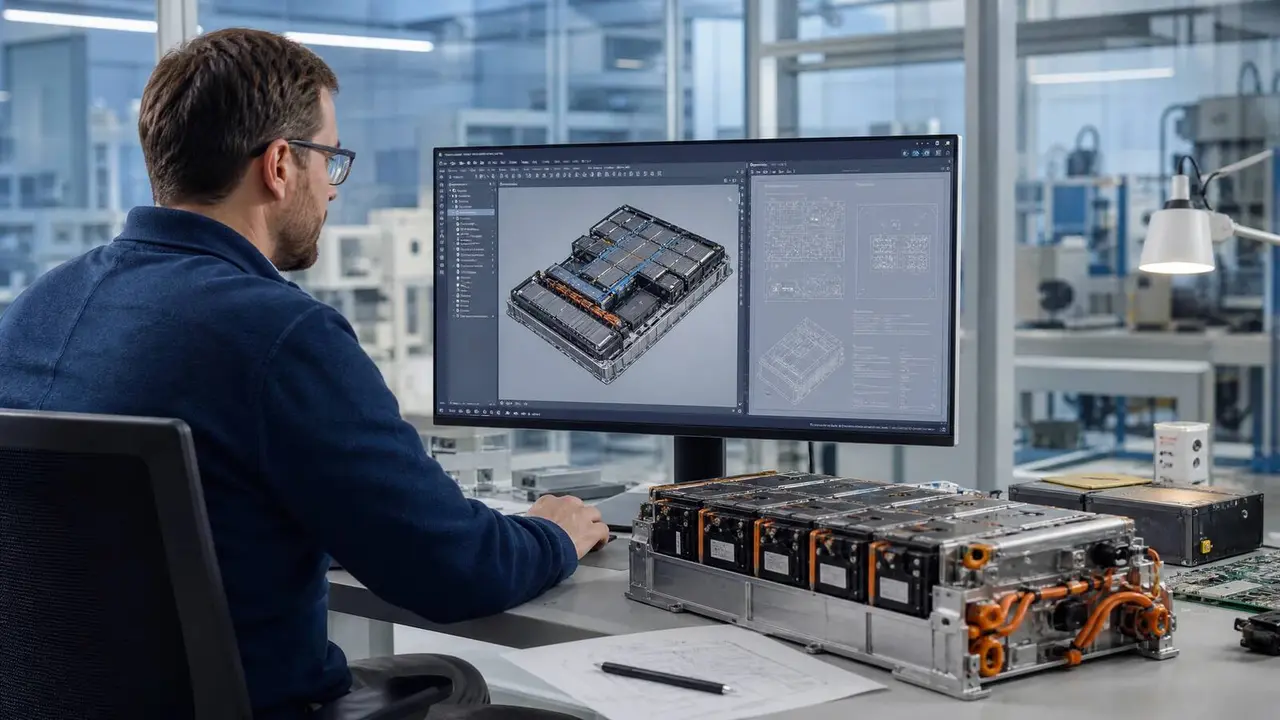
> Current operating model: Lithium Battery Company is a US-based battery engineering and sourcing partner. Current customer programs use qualified production partners selected for the battery, volume, quality, and compliance requirements. LBC's planned Tampa manufacturing operation is not yet commissioned. Compliance and country-of-origin claims are confirmed only for a specific bill of materials, production path, and contract.
Custom lithium battery packs are the backbone of modern OEM product development. Whether you are designing a medical device, a defense system, an industrial robot, or a consumer product, the battery pack is often the most critical — and most complex — component in your design.
This guide covers everything you need to know about custom lithium battery pack development — from initial specification through production.
Why Custom vs. Off-the-Shelf
Off-the-shelf battery packs are designed for the broadest possible market. They make compromises in voltage, capacity, form factor, and BMS configuration that may not align with your specific application requirements.
Custom battery packs are designed around your application. The voltage, capacity, cell chemistry, form factor, connector type, BMS configuration, and communication interface are all specified to match your system requirements exactly.
For OEM programs, custom packs also provide:
- Competitive differentiation: Your product performs better because its power system is optimized for it
- Supply chain control: You own the specification, not a commodity supplier
- Certification alignment: The pack is designed and tested to meet the certifications your product requires
- Voltage: What voltage does your system require? What is the acceptable voltage range during discharge?
- Capacity: How much energy do you need? What is your average current draw and required runtime?
- Peak current: What is the maximum current your system draws during startup or peak operation?
- Form factor: What are the dimensional constraints? What is the maximum weight?
- Environment: What temperature range will the pack operate in? What ingress protection is required?
- Certifications: What certifications does your product require (UL, CE, UN38.3, IEC62133, MIL-STD-810)?
- Communication: Does your system require BMS communication (CAN, RS485, SMBus, Bluetooth)?
The Custom Pack Development Process
Step 1: Application Analysis
The first step is understanding your application requirements:
Step 2: Chemistry and Cell Selection
Based on your application requirements, we select the appropriate chemistry (LFP or NMC) and cell format (cylindrical, prismatic, or pouch). Cell selection considers energy density, cycle life, temperature performance, and cost.
Step 3: Pack Architecture Design
The pack architecture defines how cells are arranged in series and parallel to achieve the required voltage and capacity, the mechanical design of the enclosure, thermal management approach, and BMS architecture.
Step 4: BMS Specification
The Battery Management System is specified to match the pack architecture and application requirements. BMS configuration includes protection thresholds, balancing strategy, communication interface, and any application-specific firmware requirements.
Step 5: Prototype Build and Testing
Prototype packs are built and subjected to comprehensive testing including capacity verification, cycle testing, thermal testing, and application-specific performance testing. Testing results are used to refine the design before production.
Step 6: Certification Testing
If your application requires certification (UL, CE, UN38.3, IEC62133, MIL-STD-810), the pack is submitted for third-party testing and certification.
Step 7: Production
Once the design is validated and certified, production begins. Production scale and capacity are confirmed for each program with the selected qualified production partner.
Key Specifications Reference
| Parameter | Typical Range | |---|---| | Voltage | 12V – 144V | | Capacity | 1Ah – 1,000Ah+ | | Cell Chemistry | LFP, NMC/NCM | | Cell Format | Cylindrical, Prismatic, Pouch | | Operating Temperature | -20°C to +60°C | | Ingress Protection | IP54 – IP68 | | Communication | CAN, RS485, SMBus, Bluetooth |
Why Lithium Battery Company
Lithium Battery Company has been manufacturing custom lithium battery packs for OEM programs for over a decade. Our customers include defense contractors, medical device manufacturers, industrial equipment OEMs, marine builders, and consumer electronics companies.
Our engineering team works directly with your program from specification through production. We offer:
- Custom cell selection from qualified cell manufacturers
- In-house BMS design and programming
- Mechanical design and enclosure engineering
- Comprehensive testing and certification support
- Scalable production from prototype to volume
Contact us to discuss your custom battery pack requirements.