

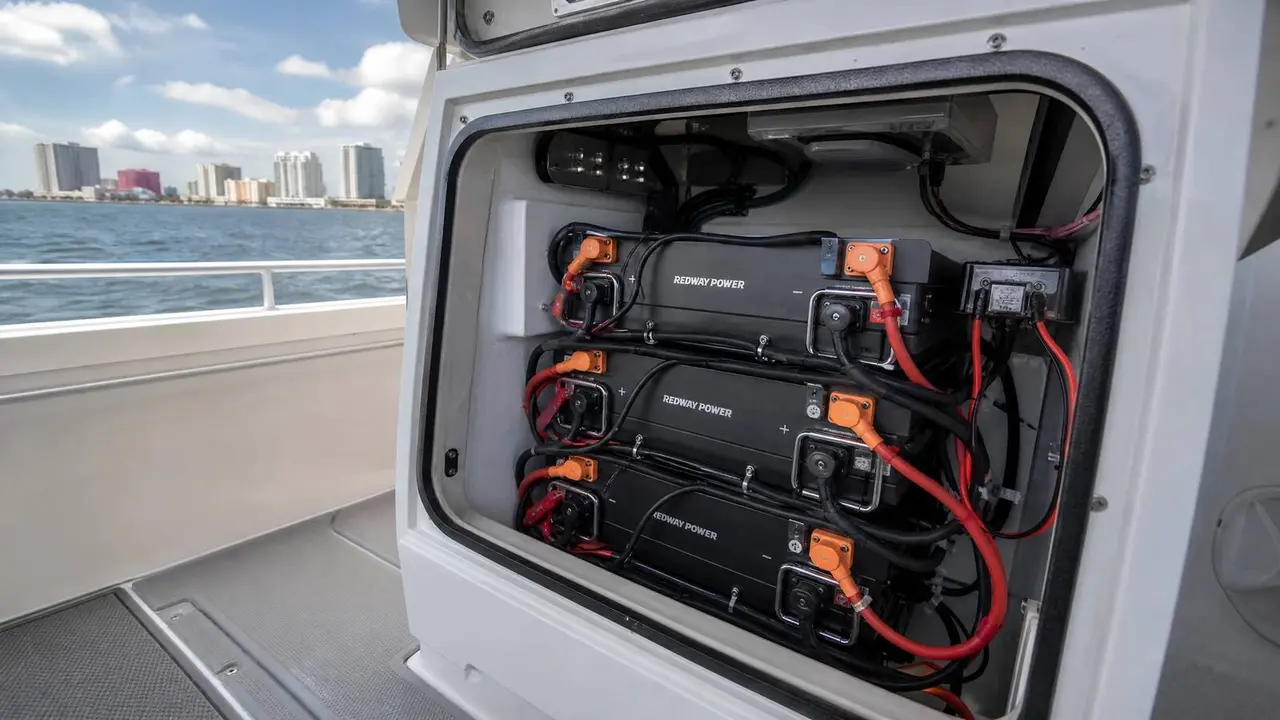
Marine lithium batteries are transforming boating — delivering longer runtime, lighter weight, and more reliable power than traditional lead-acid batteries. Here is what every boat owner and marine OEM needs to know.
Why Marine Applications Demand Better Batteries
The marine environment is one of the most demanding for battery systems. Salt air accelerates corrosion. Vibration and shock from waves stress mechanical connections. Temperature swings from cold mornings to hot summer afternoons challenge cell chemistry. And when you are on the water, battery failure is not just an inconvenience — it can be a safety issue.
Traditional lead-acid batteries have served the marine market for decades, but they come with significant limitations:
- Weight: A 100Ah lead-acid battery weighs 25–30 kg. The equivalent LFP battery weighs 12–14 kg.
- Usable capacity: Lead-acid should not be discharged below 50% to preserve cycle life. LFP can be safely discharged to near 0%.
- Cycle life: Lead-acid delivers 300–500 cycles. LFP delivers 2,000–5,000 cycles.
- Charge acceptance: Lead-acid charges slowly and inefficiently. LFP accepts charge at high rates.
The Lithium Advantage for Marine Applications
Weight Reduction: Switching from lead-acid to LFP typically reduces battery weight by 50–60%. For sailboats, this weight reduction improves performance and reduces heel. For powerboats, it improves fuel efficiency and handling.
Doubled Usable Capacity: Because LFP can be safely discharged to near 0%, a 100Ah LFP battery delivers approximately twice the usable energy of a 100Ah lead-acid battery. You can run your electronics, refrigerator, and lighting longer between charges.
Faster Charging: LFP batteries accept charge at high rates, allowing you to replenish your house bank quickly from your engine alternator or shore power. A properly configured LFP system can charge in 2–3 hours versus 8–10 hours for lead-acid.
Longer Life: LFP batteries last 5–10 times longer than lead-acid batteries. The higher upfront cost is offset by the elimination of frequent replacements.
Flat Discharge Curve: LFP batteries maintain a relatively constant voltage throughout most of their discharge cycle. Your electronics receive consistent power until the battery is nearly depleted, rather than experiencing voltage sag as lead-acid batteries discharge.
Marine-Specific Design Requirements
Not all lithium batteries are suitable for marine use. Marine-specific requirements include:
Ingress Protection: Marine batteries must be protected against water intrusion. IP67 rating (immersion to 1 meter for 30 minutes) is the minimum standard for marine house bank applications.
Corrosion Resistance: Enclosures and terminal hardware must be resistant to salt air corrosion. Marine-grade stainless steel terminals and sealed enclosures are essential.
Vibration and Shock Resistance: Marine batteries experience significant vibration and shock from waves and engine operation. Cell mounting and BMS connections must be designed to withstand these forces.
Temperature Range: Marine batteries must operate reliably across the temperature range encountered in boating — from cold winter mornings to hot summer afternoons in a sealed engine compartment.
Lithium Battery Company Marine Solutions
Lithium Battery Company supports marine lithium battery programs for OEM boat builders, marine dealers, and qualified volume buyers. Our marine batteries are designed specifically for the demands of the marine environment.
We offer standard marine battery configurations in common group sizes (Group 24, 27, 31) and custom configurations for OEM boat builders with specific requirements.
Contact us to discuss your marine battery requirements.