
> Current operating model: Lithium Battery Company is a US-based battery engineering and sourcing partner. Current customer programs use qualified production partners selected for the battery, volume, quality, and compliance requirements. LBC's planned Tampa manufacturing operation is not yet commissioned. Compliance and country-of-origin claims are confirmed only for a specific bill of materials, production path, and contract.
There is a story that gets told in boardrooms and procurement departments across America, and it goes like this: Chinese battery manufacturing is cheaper, faster to scale, and too entrenched to compete with. The cost gap is too large. The supply chain is too established. The window for domestic manufacturing has closed.
I am here to tell you that story is wrong. I know it is wrong because I built the proof.
Lithium Battery Company manages battery engineering and sourcing programs from Tampa for defense, UAV, telecom, and industrial OEM buyers. Current production uses qualified partners; the planned Tampa manufacturing operation is not yet commissioned.
This is not a government-subsidized vanity project. This is a commercially viable manufacturing operation that exists because the economics have fundamentally changed — and because I started building before most people realized they had changed.
The Myth of the Unbeatable Chinese Cost Advantage
The 40% cost advantage that Chinese battery manufacturers held in 2018 has been systematically eroded by three forces that were entirely predictable to anyone paying attention.
Tariffs. Section 301 tariffs on Chinese battery imports have escalated to 67%+ for many categories. A battery pack that a Chinese manufacturer quotes at $100 now costs $167 or more to land in the United States. The cost advantage that justified the supply chain complexity has not just disappeared — it has inverted into a penalty.
NDAA compliance. For any company selling to the US government, defense contractors, or federally funded programs, Chinese-sourced batteries are a disqualifying liability under NDAA Section 841. The federal procurement market — which represents hundreds of billions of dollars in annual spending — is effectively closed to Chinese battery supply chains. A domestic manufacturer does not just compete on price in this market. We are the only option.
Lead time reality. The 4-week lead time your Chinese supplier quotes is a fiction. The real number — including factory lead time, ocean freight, port processing, and customs clearance — is 60–120 days on a good day. When ocean freight capacity tightens or customs holds multiply, it can be 180 days. American manufacturers running lean production schedules cannot absorb that variability. LBC confirms lead time only after reviewing the specification, components, validation scope, volume, and selected production path.
When you add up the tariff cost, the NDAA compliance risk, and the true cost of 90-day lead time variability in your production schedule, Chinese battery sourcing is not cheaper. It is more expensive — and more dangerous.
What I Built and Why I Built It This Way
I started building LBC's manufacturing infrastructure in late 2024, specifically because I saw the tariff trajectory, the NDAA enforcement trend, and the supply chain vulnerability that American manufacturers were accumulating. I wanted to build something that could actually compete — not a boutique operation that serves a niche, but a full-scale manufacturing facility that can handle volume.
LBC's domestic roadmap contemplates multiple pack formats, prototyping, testing, and BMS integration. Those planned capabilities are not yet commissioned, so present programs are scoped against the equipment and quality systems of the selected production partner.
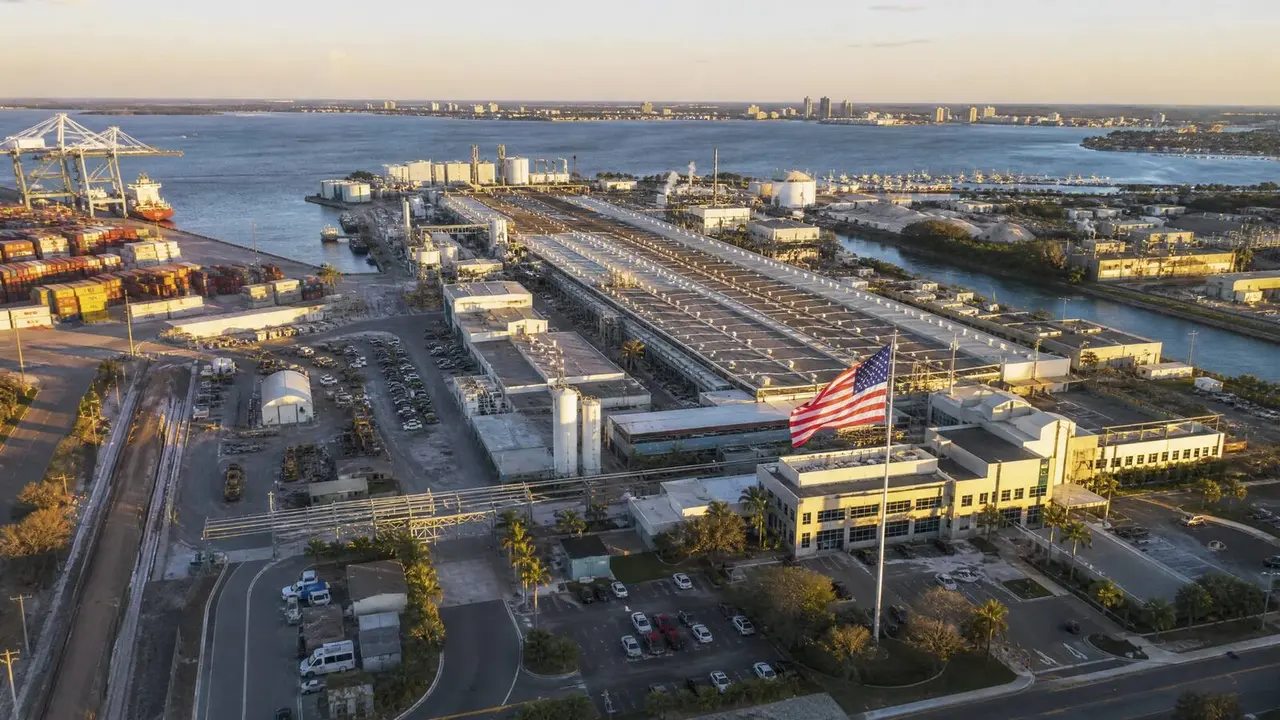
The facility is in a Foreign Trade Zone at the Port of Tampa — which provides duty deferral and inverted tariff relief for qualifying programs, and gives us direct access to the logistics infrastructure of one of the Southeast's major ports.
We support LFP and NMC battery programs from 12V to 144V, from 10 units to 300,000+ annual units. We can reverse-engineer any existing battery design and produce a domestic equivalent without requiring a single change to the customer's product.
This is not a small operation. This is the infrastructure that American battery manufacturing needed.
The Companies That Are Calling Us
I want to be specific about who is finding us and why, because it tells a story about where American manufacturing is headed.
Defense contractors are calling because NDAA Section 841 enforcement has become aggressive and their procurement teams are under pressure to clean up their supply chains. They need a domestic manufacturer who can handle the documentation requirements, the compliance certifications, and the volume — and they need it now, not in 18 months.
UAV manufacturers are calling because their Chinese battery suppliers are on NDAA covered entity lists, and the defense programs that buy their drones are requiring domestic battery sourcing. They need a drop-in replacement that matches their existing pack spec without requiring a redesign of their airframe.
Telecom infrastructure operators are calling because they are replacing aging VRLA lead-acid backup systems at cell towers and data centers, and they need LFP packs that meet their cycle life and temperature requirements. They have been sourcing from Chinese manufacturers, and the tariff exposure has made the economics of domestic sourcing competitive for the first time.
Industrial OEMs are calling because their procurement teams have done the math on tariff exposure and decided that the cost of transitioning to domestic supply is less than the cost of continuing to absorb 67% tariffs on Chinese imports.
These are not ideologically motivated decisions. These are commercially rational decisions made by procurement professionals who have looked at the numbers and concluded that domestic manufacturing is the right answer.
The Jobs That Come With the Factory
I want to talk about something that does not get discussed enough in the battery manufacturing conversation: the jobs.
Every production line we run creates skilled manufacturing jobs in Tampa, FL. Battery pack assembly is not unskilled labor — it requires training in electrical safety, cell handling, BMS programming, quality control, and precision assembly. These are jobs that pay living wages, that build skills, and that create the kind of manufacturing workforce that American communities have been losing for thirty years.
When an American company switches from a Chinese battery supplier to LBC, they are not just improving their supply chain security. They are creating American jobs. They are building American manufacturing capability. They are contributing to the reshoring of an industry that the United States ceded to China over two decades of short-term cost optimization.
I believe that American manufacturing can compete. I believe that the combination of tariff policy, NDAA enforcement, and supply chain security concerns has created a genuine window for domestic manufacturers to rebuild the capability that was offshored. And I believe that the companies that make the transition now — while the window is open and the transition can be managed on their terms — will be better positioned than the companies that wait.
The domestic roadmap remains a planned commissioning project. LBC's current proof is its engineering, sourcing, reference-design, and production-partner experience.
Frequently Asked Questions
Q: Is US battery manufacturing actually cost-competitive with China? When you include the true landed cost of Chinese imports — Section 301 tariffs (up to 67%), ocean freight, customs clearance, and the cost of 60–120 day lead time variability in your production schedule — domestic manufacturing is competitive for most applications at volumes above 1,000 units annually. For defense and government programs, where NDAA compliance is required, domestic manufacturing is the only option regardless of cost.
Q: What is the minimum order quantity at LBC? We accept prototype runs starting at 10 units. Volume pricing begins at 100 units. For annual programs above 10,000 units, we offer dedicated production scheduling and volume pricing agreements.
Q: How does LBC handle NDAA compliance documentation? LBC can coordinate program-specific source documentation and supplier declarations when those deliverables are defined and supported by the selected production path. This includes a Certificate of Compliance, Bill of Materials with country-of-origin documentation for all components, and a signed supplier declaration. We can also support DFARS compliance requirements for defense programs.
Q: Can LBC handle confidential OEM designs? Yes. We sign NDAs before reviewing any proprietary specifications. Design access, confidentiality, and production-partner data sharing are defined by the program and its agreements. LBC can sign an NDA before reviewing proprietary specifications. We treat customer IP with the same seriousness as our own.