
> Current operating model: Lithium Battery Company is a US-based battery engineering and sourcing partner. Current customer programs use qualified production partners selected for the battery, volume, quality, and compliance requirements. LBC's planned Tampa manufacturing operation is not yet commissioned. Compliance and country-of-origin claims are confirmed only for a specific bill of materials, production path, and contract.
In 2000, Blockbuster had the chance to buy Netflix for $50 million. Their CEO laughed the founders out of the room. A decade later, Blockbuster filed for bankruptcy. Netflix is worth $280 billion.
I think about that story a lot.
Not because I'm in the entertainment business. But because I watch American manufacturers make the same mistake every single day — and I'm watching the window close on their ability to fix it.
The Inflection Point Nobody Saw Coming (Except the People Who Were Paying Attention)
For thirty years, the calculus was simple: source your batteries from China, save 40% on unit cost, and move on. The supply chain worked. The tariffs were manageable. The geopolitical risk was theoretical.
Then 2025 happened.
Section 301 tariffs stacked on top of Section 232 tariffs. NDAA Section 841 went from a footnote in defense contracts to a disqualifying clause in every federal procurement. Lead times from Chinese suppliers ballooned to 90–120 days as ocean freight capacity tightened and customs holds multiplied. And somewhere in a Shenzhen factory, an American company's proprietary battery design was being reverse-engineered by a competitor who would undercut them at the next trade show.
The economics that made Chinese battery sourcing attractive didn't just erode. They inverted.
A battery pack that cost $100 from a Chinese supplier in 2022 now effectively costs $167 or more when imported into the United States. That's not a cost advantage. That's a 67% penalty for not having solved this problem three years ago.
What Nathan Staron Saw That Most People Missed
I started building the infrastructure for this moment in late 2024 — before the tariffs hit their current levels, before the NDAA enforcement became aggressive, before most American manufacturers had even started thinking about their exposure.
Why? Because I'd been watching the trajectory for years. The signals were everywhere if you were paying attention:
- The CHIPS Act wasn't just about semiconductors. It was a signal that the US government had decided domestic manufacturing of critical technology was a national security issue. Batteries were next.
- The defense procurement community had been quietly tightening NDAA language for three consecutive authorization cycles. The enforcement was coming.
- The tariff escalation had a clear political trajectory regardless of which party won in 2024. Both sides of the aisle had decided that Chinese manufacturing dependency was a problem.
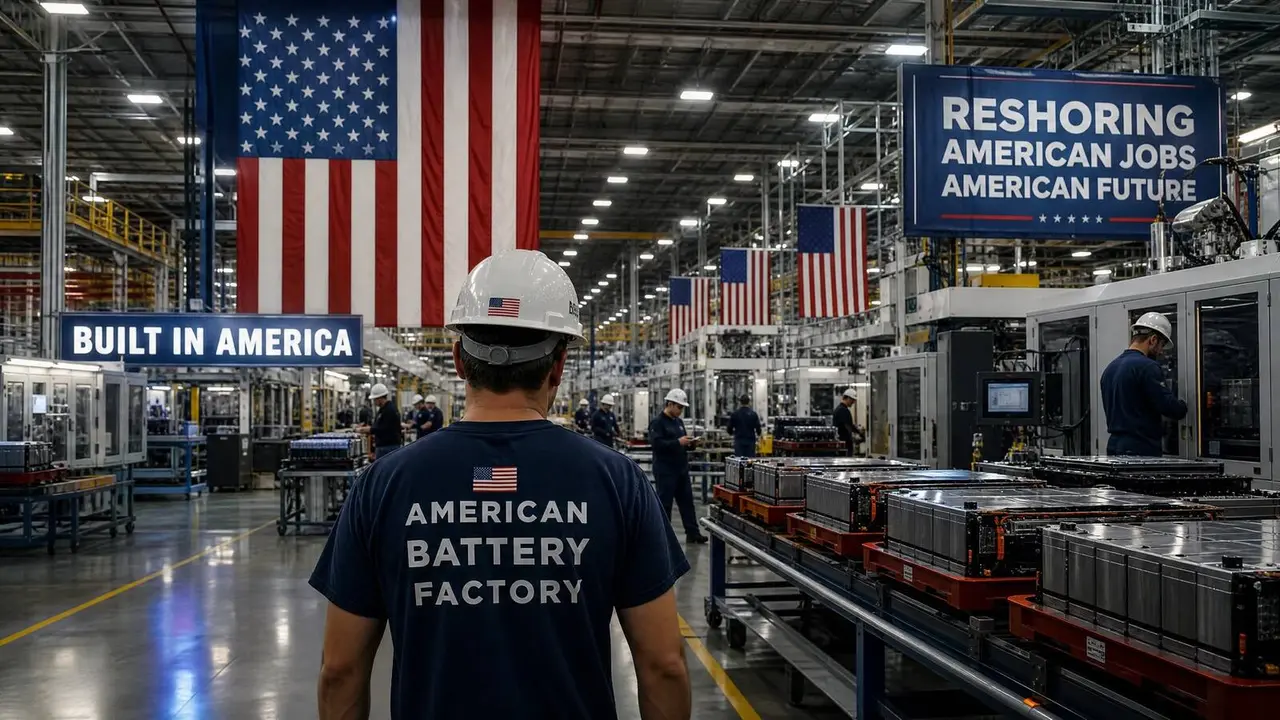
So while other battery companies were still optimizing their China supply chains, I was buying equipment. Five production lines. 84,000 square feet in Tampa, FL. A Foreign Trade Zone location at the Port of Tampa. US-qualified cell suppliers. An engineering team that can reverse-engineer any existing battery design and produce a domestic equivalent without requiring a single change to the customer's product.
The planned domestic operation is not yet commissioned. Current customer programs continue through qualified production partners while LBC pursues the capital and commitments required for the Tampa roadmap.
The Blockbuster Parallel Is More Exact Than It Looks
Blockbuster's problem wasn't that they didn't see Netflix coming. Their problem was that they couldn't bring themselves to cannibalize their own business model to respond.
American manufacturers face the same psychological barrier. Switching battery suppliers means renegotiating contracts, requalifying components, updating documentation, and having a conversation with procurement about why the unit cost is going up in the short term before it comes down at volume.
It's uncomfortable. It's work. And as long as the Chinese supplier keeps shipping on time and the tariff exposure feels manageable, it's easy to defer.
But here's what Blockbuster's executives didn't understand until it was too late: the cost of inaction compounds. Every quarter you defer the supply chain transition is another quarter of tariff exposure, another quarter of NDAA risk accumulating in your contract portfolio, another quarter of lead time risk in your production schedule.
The companies that are making the transition now are doing it on their terms — controlled timelines, prototype validation, gradual volume ramp. The companies that wait until they have no choice will be doing it in crisis mode, paying premium prices for expedited production, and explaining to their customers why delivery is delayed.
The Chemistry Is About to Change Everything Again
Here's what most people in this industry aren't talking about yet: the next wave of battery chemistry disruption is already in the lab, and it's going to make the LFP-vs-NMC debate look like arguing about which horse is faster right before the automobile was invented.
Sodium-ion cells are approaching commercial viability at energy densities that make them competitive with LFP for stationary storage — without any lithium, cobalt, or nickel. The raw materials are essentially unlimited and geographically distributed. No single country controls the supply chain.
Solid-state electrolytes are moving from research papers to pilot production lines. The energy density numbers being reported — 400–500 Wh/kg versus NMC's 250 Wh/kg — would represent a fundamental change in what's possible for UAV endurance, electric vehicle range, and portable military power.
Silicon anode cells are already in limited commercial production, delivering 20–40% higher energy density than conventional graphite anode cells in the same form factor.
The companies that build their domestic battery manufacturing relationships now will be the first to access these next-generation chemistries when they reach commercial scale. The companies still sourcing from China will be waiting for their Chinese suppliers to decide when to give them access — and on what terms.
I'm not building a battery company. I'm building the manufacturing infrastructure that American industry will need for the next fifty years. The chemistry will change. The applications will evolve. The one thing that won't change is the strategic value of having a domestic manufacturing partner who can move as fast as the technology does.
The Window Is Closing
Blockbuster had a window. It was open for years. Then it closed.
The window for American manufacturers to transition their battery supply chains on favorable terms is still open — but it's narrowing. The companies that act in the next 12–18 months will transition at their pace, on their timeline, with prototype validation and controlled cost ramps.
The companies that wait will transition in crisis — because the tariffs will keep rising, the NDAA enforcement will keep tightening, and eventually a supply chain disruption will force the issue at the worst possible moment.
I built the factory. I bought the equipment. I hired the engineers.
The only question is whether you're going to be the company that called us in 2025, or the company that called us in 2027 when you had no other choice.
Frequently Asked Questions
Q: What is the fastest way to start transitioning from a Chinese battery supplier to a US manufacturer? Send your existing battery specification to Lithium Battery Company. We'll identify a domestic equivalent or design a custom replacement, quote within 48 hours, and have a prototype in your hands in 4–6 weeks. The transition starts with a single email.
Q: How much does it cost to switch from a Chinese battery supplier to LBC? The unit cost comparison depends on your specific configuration and volume. At volumes above 1,000 units annually, LBC's pricing is typically competitive with Chinese suppliers when tariff costs are included in the Chinese supplier's true landed cost. Below that volume, there is often a modest premium — which most customers find acceptable given the supply chain security, NDAA compliance, and lead time advantages.
Q: Do I have to redesign my product to use a domestic battery? No. LBC's China Exit program is specifically designed to produce drop-in replacements for existing Chinese battery designs. We reverse-engineer the form factor, voltage, capacity, BMS configuration, and connector interface. Your product doesn't change. Your supply chain does.
Q: What chemistries does LBC manufacture? We manufacture LFP (lithium iron phosphate) and NMC/NCM (nickel manganese cobalt) packs — the two chemistries that cover 95% of serious OEM applications. We are actively monitoring sodium-ion and solid-state developments and will be among the first US manufacturers to offer these chemistries at commercial scale when they are ready.